All of 13 researched countries in the MENA region, except Algeria and Lebanon, have identified the lower 6 GHz band for RLAN/Wi-Fi use.
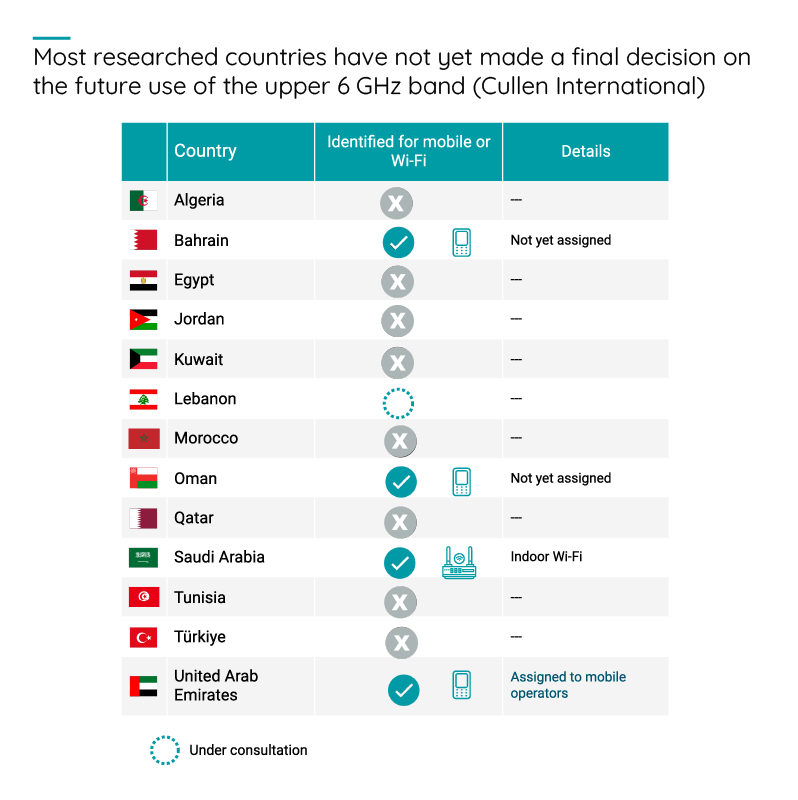
Saudi Arabia has taken the most expansive approach among the researched countries by making the full 6 GHz band available for unlicensed use, primarily for indoor Wi-Fi. CST, the Saudi regulator, plans to allow outdoor WLAN use under an automated frequency coordination (AFC) framework.
Cullen International’s new benchmark examines regulatory treatment of the 6 GHz band, which is attracting increasing regulatory attention as demand grows for additional spectrum to support Wi-Fi and mobile broadband services.
Historically, the band has been used mainly by fixed services, including point-to-point links and satellite services. However, regulators are now considering the band to support future wireless demand.
The upper 6 GHz band remains subject to differing regulatory approaches. Bahrain, Oman and the United Arab Emirates (UAE) have identified this band for mobile services, although only the UAE has so far announced the official assignment of this spectrum to mobile operators.
e& in the UAE plans a commercial launch of mobile services in the upper 6 GHz band by the end of 2026, using 350 MHz of spectrum.
Cullen International’s new benchmark provides information for selected MENA countries on:
- whether the lower 6 GHz band has been made available for RLAN/Wi-Fi use;
- whether the upper 6 GHz band has been identified or assigned for mobile services; and
- the operating environment for allowed technologies.
Scope
- Region: Middle East & North Africa
- Countries covered: 13 MENA countries
- Policy area: radio spectrum
- Last updated: June 2026
For more information or to access the benchmark, please click on “Access the full content” - or on “Request Access”, in case you are not subscribed to our MENA Telecoms service.
more news
19 August 26
Regulating submarine cable infrastructure
Our latest Global Trends benchmark analyses policies and regulations of relevance to international submarine cables used for electronic communications in 17 jurisdictions around the world.
18 August 26
Countries around the world take different approaches to data centre development
Cullen International’s new benchmark provides insights into how 19 countries, including 13 in Europe, have introduced rules to incentivise and/or regulate the development of data centres.
17 August 26
Most countries in the Americas region tax over-the-top services
This Cullen International benchmark shows for each surveyed country whether OTT video and music service providers are subject to any regulation and/or taxation; or if there are national plans to adopt applicable regulations or taxes.