Key findings
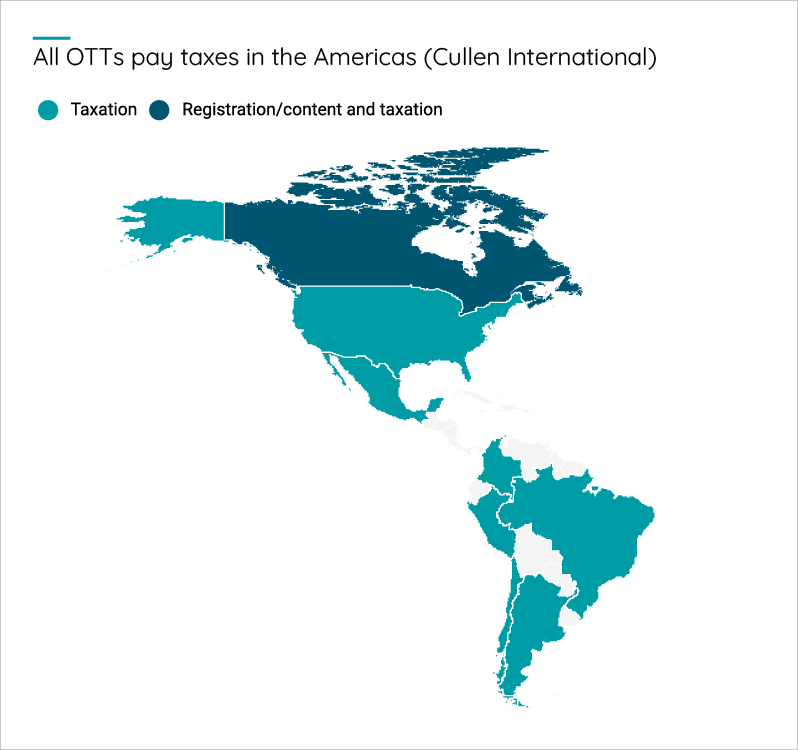
Six of eight studied countries in the Americas subject over-the-top (OTT) providers to some form of national and/or local taxation.
In addition, some countries impose obligations on video OTT providers that resemble those applied to legacy audiovisual market players. Canada includes streaming and social media services within the definition of a broadcast undertaking, while Colombia requires OTT catalogues to include an easy-to-find section for national works.
Why it matters
The regulatory and tax treatment of OTT services can affect the competitive relationship between online audiovisual providers and traditional linear video distribution operators, such as cable, satellite and over-the-air television providers.
What the content covers
Cullen International’s updated benchmark reviews the regulation and taxation of OTT audiovisual services in eight countries in the Americas. The benchmark focuses on whether OTT providers are subject to obligations that also apply to traditional audiovisual market players, if OTT services are legally defined, and whether OTT-specific regulation is planned.
Scope
Region: Americas
Countries covered: Argentina, Brazil, Canada, Chile, Colombia, Mexico, Peru and United States.
Policy area: OTT regulation, audiovisual regulation and taxation
Published: 3 August 2026
For more information and access to the full benchmark, please click on “Access the full content” - or on “Request access”, in case you are not subscribed to our Americas Media service.
more news
12 October 26
Seven of 13 European countries require opt-in for commercial calls
Cullen International's latest benchmark compares the rules on unsolicited commercial communications in 13 European countries.
09 October 26
Four LATAM countries address connectivity gaps
Cullen International’s latest LATAM Telecoms Update highlights policy developments over the past three months affecting the regulation of radio spectrum, wholesale networks and consumer protection in six markets in the region: Argentina, Brazil, Chile, Colombia, Mexico and Peru.
08 October 26
Many European countries consider banning minors from accessing social media
Cullen International has just published a new version of its benchmark which tracks the current debates/ initiatives on banning access to social media to protect minors online in Europe.