Cullen International's latest benchmark compares the rules on unsolicited commercial communications in 13 European countries.
Focusing on calls, SMS and emails, our research shows where prior consent is required for marketing communications and whether national rules limit the duration of that consent.
Main findings
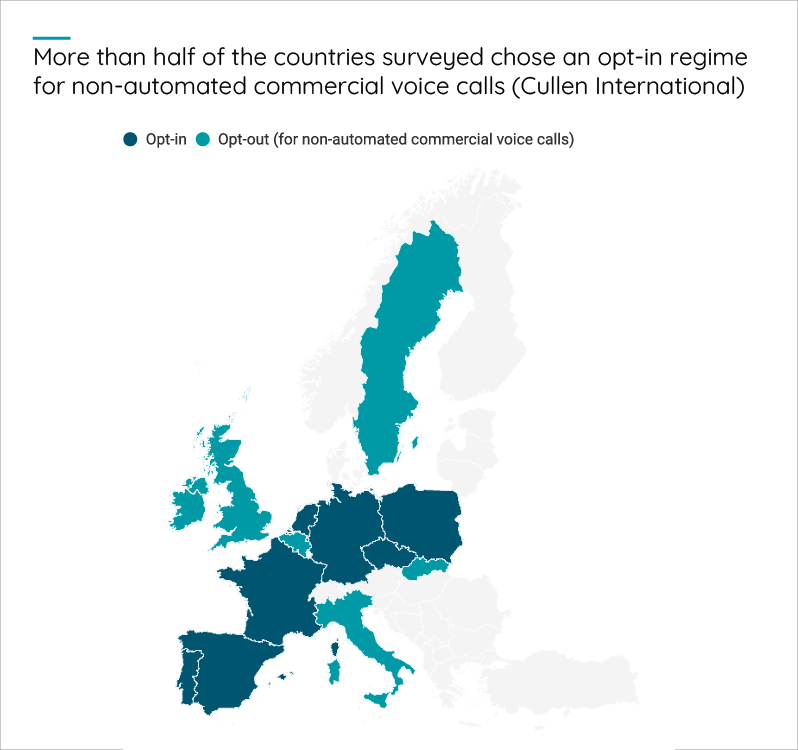
- Seven out of the 13 countries surveyed apply an opt-in regime for non-automated commercial voice calls. The remaining six countries apply an opt-out regime.
- France and Spain limit the duration of consent for commercial communications. In the Czech Republic, a two-year limit on the validity of consent is proposed.
- France and Spain also impose additional restrictions on commercial voice calls, including rules for specific sectors, permitted calling times or telephone number ranges.
Background
The EU e-Privacy Directive sets rules for unsolicited direct marketing communications. While prior consent (opt-in) is generally required for marketing by email and SMS, EU member states can choose between an opt-in and an opt-out regime for commercial voice calls not initiated by automated calling systems.
Scope
Region: Europe
Countries covered: Belgium, Czech Republic, France, Germany, Ireland, Italy, Netherlands, Poland, Portugal, Slovakia, Spain, Sweden and United Kingdom
Policy area: Consumer protection / Nuisance communications
Last updated: September 2026
For more information and access to the full benchmark, please click on “Access the full content” or “Request access” if your organisation is not subscribed to our European Consumer Protection (in Telecoms) service.
more news
30 October 26
Many governments around the globe rely on legal mechanisms to compel communications apps to cooperate in law enforcement investigations
Cullen International's latest Global Trends benchmark for number-independent communications apps regulation found that nearly all of the 13 surveyed jurisdictions around the world provide some legal mechanism to make these apps assist law enforcement in criminal investigations. There are requirements to verify user identities, compel disclosure of stored content, make encrypted content accessible, and duties to detect illegal content within private communications.
22 October 26
IoT regulation: new operational requirements reshape global connectivity
Cullen International's Quarterly Regulatory Update on IoT and M2M Services (Q3 2026) highlights how national regulators around the globe are shaping the future of IoT and M2M services.
21 October 26
Americas countries require satellite service providers to obtain a spectrum licence
Cullen International’s latest benchmark compares satellite regulation across the Americas, including service and spectrum licensing, registration requirements, spectrum allocations and fees, interference rules, migration between frequency bands and recent regulatory developments.