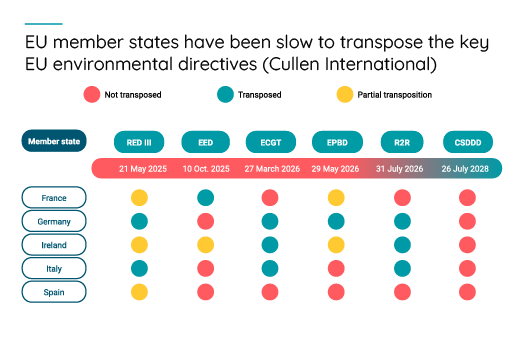
The transposition deadline for the Renewable Energy Directive III (RED) expired on 21 May 2025. Even now, only five EU member states have transposed the directive. In the latest developments, in April 2026, the Commission referred Greece, Malta and Portugal to the CJEU to impose financial sanctions for failure of transposition.
The RED is just one of a number of key pieces of EU environmental directives that member states have been slow to transpose. In many cases, the Commission has been required to take enforcement actions.
The transposition deadline for the Corporate Sustainability Due Diligence Directive was postponed to July 2028 through the Omnibus I directive.
Cullen International’s updated benchmark contains summary information on the transposition status of six key EU environmental directives in all EU member states and Norway, namely the:
- Renewable Energy Directive III (RED III)
- Energy Efficiency Directive (EED)
- Empowering Consumers for the Green Transition Directive (ECGT)
- Energy Performance of Buildings Directive
- Right to Repair Directive; and
- Corporate Sustainability Due Diligence Directive (CSDDD)
Benchmark Scope
Region: Europe
Countries covered: EU-27 and Norway
Policy area: Sustainability, Environmental
Last updated: November 2026
For more information and access to the full benchmark, please click on “Access the full content” - or on “Request access”, in case you are not subscribed to our Sustainability service.
more news
04 November 26
In nine European countries, national symmetric obligations on access to ducts go beyond the scope set by the Gigabit Infrastructure Act
Cullen International's latest benchmark analyses asymmetric and symmetric duct access obligations in Europe.
04 November 26
More than 60 cases and counting: a snapshot of European antitrust enforcement against big tech
Cullen International’s latest report on past and pending antitrust cases against big tech companies in Europe tracks enforcement activity under ex post antitrust rules at EU and national level.
30 October 26
Many governments around the globe rely on legal mechanisms to compel communications apps to cooperate in law enforcement investigations
Cullen International's latest Global Trends benchmark for number-independent communications apps regulation found that nearly all of the 13 surveyed jurisdictions around the world provide some legal mechanism to make these apps assist law enforcement in criminal investigations. There are requirements to verify user identities, compel disclosure of stored content, make encrypted content accessible, and duties to detect illegal content within private communications.