While most countries do not have national rules in place specifically for data centres, there are a number of countries that have introduced such rules, including:
- rules on energy supply in China, France, Germany, Ireland, Japan, Singapore, Spain and the USA, and proposed in Brazil and the UK;
- rules on water usage in China and Singapore, and proposed in Brazil and France; and
- rules on permitting in Brazil, China, Italy, Singapore and the USA, and proposed in France and the UK
In addition, in a number of countries, rules have been introduced or are planned, either at a national or municipality level, that would prevent or restrict the new development of data centres. For example, de facto moratoria on data centre development were in place in Ireland and Singapore until recently, while the municipality of Amsterdam and a number of US states have introduced such moratoria.
In China and Norway, data centre operators are required to hold licences, and Australia and Singapore have proposed specific regulations to govern data centre deployment and operation.
Seven of the studied countries have established national strategies for data centre development, although the intention and scope of these strategies varies considerably.
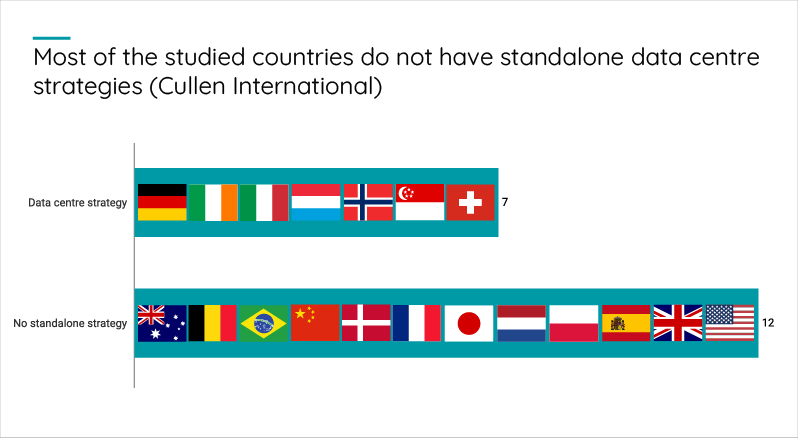
Cullen International’s new benchmark provides insights into how 19 countries, including 13 in Europe, have introduced rules to incentivise and/or regulate the development of data centres, in particular covering topics such as:
- financial and other incentives;
- special procedures for permitting;
- preventing any distortion in the demand for energy;
- protecting local areas from over-consumption of water supplies; and
- examples of rules to prevent or restrict the further deployment of data centres.
Benchmark Scope
Region: Europe and global
Countries covered: 19 countries in total, 13 in Europe
Policy area: Sustainability, Environmental
For more information and access to the full benchmark, please click on “Access the full content” - or on “Request access”, in case you are not subscribed to our Sustainability service.
more news
15 October 26
Europe: national rules continue to shape cross-border IoT connectivity
Europe is often treated as a single market for IoT connectivity but, in practice, national rules on SIM registration, numbering and authorisation still differ between countries. Cullen International's latest benchmarks examine these rules across 31 European markets.
14 October 26
Regulators worldwide take several distinct approaches to legally defining communications apps, authorise their operation and govern their interoperability
Cullen International's latest Global Trends benchmark for communications apps regulation found diverse regulatory approaches to the legal definition, licensing and interoperability of number-independent communications apps. The benchmark addresses regulation of apps such as WhatsApp, WeChat and iMessage across 13 jurisdictions around the world.
13 October 26
Almost half of surveyed countries in the Americas have commercial D2D satellite services
Cullen International’s latest Benchmark compares the regulatory conditions for D2D satellite services using terrestrial IMT spectrum across 12 countries in the Americas.