Our latest benchmark shows whether, in selected European countries, the law or the national regulator imposes an obligation on fixed and/or mobile operators to compensate their customers when their voice or data networks fail.
In 11 of the 13 European countries studied, consumers have a legal right to compensation in the event of service failures. No such obligation exists in Ireland and Slovakia, but operators in both countries must provide information on any compensation that may apply if the contracted service quality levels are not met.
Most countries set minimum and/or maximum compensations per customer, depending on the type of service and subscription, as well as the duration of the outage.
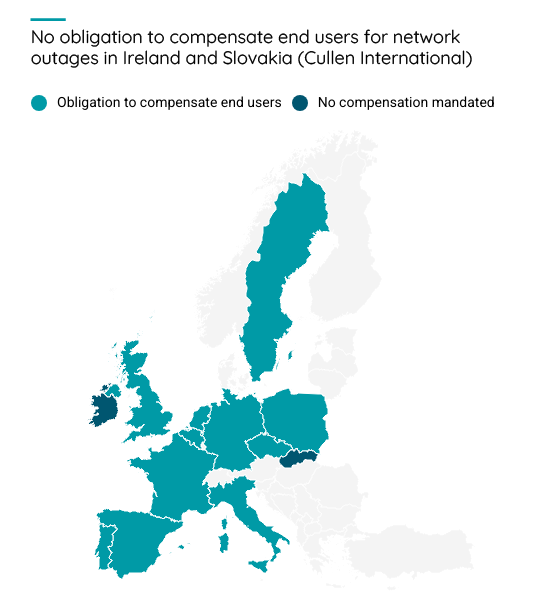
Outages caused by force majeure are generally not eligible for compensation. However, the current EU regulatory framework requires member states to take all necessary measures to ensure the fullest possible availability of voice and internet services provided over public electronic communications networks, in the event of catastrophic network breakdown or in cases of force majeure (article 108 of the European Electronic Communications Code).
Scope
Region: Europe
Countries covered: 13 (Belgium, Czech Republic, France, Germany, Ireland, Italy, Netherlands, Poland, Portugal, Slovakia, Spain, Sweden, UK)
Policy area: Consumer protection, contract regulation, quality of service
Last updated: January 2026
For more information and access to the benchmark, please click on “Access the full content” - or on “Request Access”, in case you are not subscribed to our European Consumer Protection (in Telecoms) service.
more news
20 May 26
Spectrum sharing in Europe
Spectrum is a scarce resource and can be used more efficiently when multiple users agree to share it. Cullen International designed two new benchmarks that examine the regulation and practice of spectrum sharing in 21 European countries.
13 May 26
Protection of minors: national rules to protect minors from exposure to pornographic content in Europe
Our latest benchmark shows the initiatives proposed or in place in selected European countries to control or restrict the exposure of minors to online pornographic content.
12 May 26
Some EU member states pre-empt EU level small parcel handling fee
Our new benchmark shows whether EU member states are applying a specific small parcel handling fee, compares fee levels, the legal basis, collection mechanisms, and implementation status.