Cullen International has just published an updated version of its benchmark showing if in some selected countries there are debates/initiatives on banning access to social media with the aim of protecting minors.
These initiatives have come after the European Commission adopted non-binding guidelines on article 28 of the Digital Services Act (DSA) which detail what online platforms should do to protect minors online. In the guidelines, the Commission seems to recognise the ability of the member states to adopt bans, but the matter is not clear from a legal point of view. Indeed, it is uncertain if these initiatives imposing a digital majority are compatible with the DSA.
Initiatives in thirteen countries
The benchmark shows that thirteen out of the fifteen countries surveyed are debating or have initiatives (in place or proposed) which aim to ban minors from accessing social media.
Out of these thirteen countries, only Denmark, France, Italy and Spain are proposing legislation.
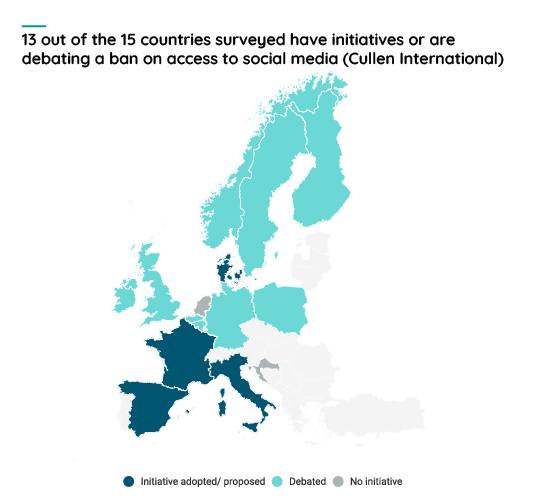
In the other countries (Belgium, Germany, Ireland, Norway, Poland, Sweden and the UK), the matter is also being debated or is subject to studies or consultation, without any legislative initiative at this stage. Poland specified that it is preparing a parliamentary bill based on the Australian model, and Belgium announced that a proposal could be adopted by the end of 2026.
For more information and access to the benchmark, please click on “Access the full content” - or on “Request Access”, in case you are not subscribed to our European Media service.
more news
04 November 26
In nine European countries, national symmetric obligations on access to ducts go beyond the scope set by the Gigabit Infrastructure Act
Cullen International's latest benchmark analyses asymmetric and symmetric duct access obligations in Europe.
04 November 26
More than 60 cases and counting: a snapshot of European antitrust enforcement against big tech
Cullen International’s latest report on past and pending antitrust cases against big tech companies in Europe tracks enforcement activity under ex post antitrust rules at EU and national level.
30 October 26
Many governments around the globe rely on legal mechanisms to compel communications apps to cooperate in law enforcement investigations
Cullen International's latest Global Trends benchmark for number-independent communications apps regulation found that nearly all of the 13 surveyed jurisdictions around the world provide some legal mechanism to make these apps assist law enforcement in criminal investigations. There are requirements to verify user identities, compel disclosure of stored content, make encrypted content accessible, and duties to detect illegal content within private communications.