Austria and Malta have recently adopted national legislation to transpose the Corporate Sustainability Reporting Directive (CSRD).
Five member states are still transposing the CSRD, having missed the 6 July 2024 transposition deadline. The Commission originally issued formal infringement notice letters to 17 member states for their failure to transpose the CSRD fully, with infringement proceedings still pending for eight member states (including Czech Republic for partial transposition and those against Austria and Malta, which should presumably soon be closed).
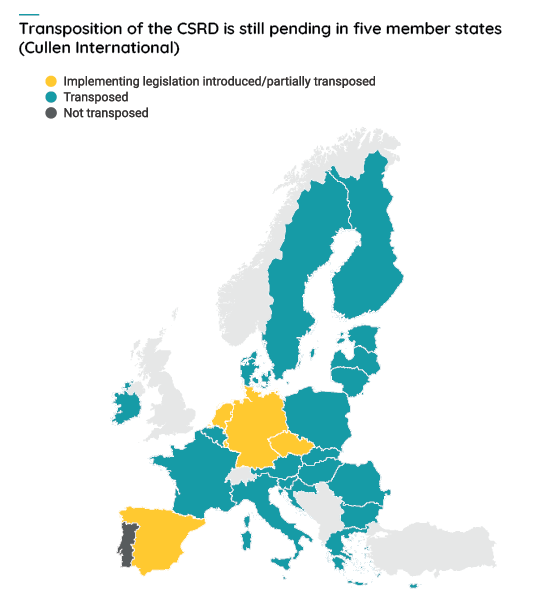
The Commission decided to postpone the application of the CSRD by one year for large enterprises, parents of large enterprises and SMEs with securities listed in the EU (i.e. "stop-the-clock” directive). Three more member states (Austria, Croatia and Sweden) have transposed the “stop-the-clock” directive since Cullen’s December update.
The CSRD requires all large companies to publish regular reports on their environmental and social impact activities. The directive defines a common reporting framework for non-financial data, which aims to ensure that businesses report reliable and comparable sustainability information.
Cullen International’s latest benchmark tracks the progress made by the 27 EU member states in transposing the CSRD and the related “stop-the-clock” directive.
Scope
Region: Europe
Countries covered: All EU member states
Policy area: Sustainability
Last updated: February 2026
For more information on the benchmark and Cullen's complete CSRD coverage, please click on “Access the full content” - or on “Request Access”, in case you are not subscribed to our Sustainability service.
more news
04 November 26
In nine European countries, national symmetric obligations on access to ducts go beyond the scope set by the Gigabit Infrastructure Act
Cullen International's latest benchmark analyses asymmetric and symmetric duct access obligations in Europe.
04 November 26
More than 60 cases and counting: a snapshot of European antitrust enforcement against big tech
Cullen International’s latest report on past and pending antitrust cases against big tech companies in Europe tracks enforcement activity under ex post antitrust rules at EU and national level.
30 October 26
Many governments around the globe rely on legal mechanisms to compel communications apps to cooperate in law enforcement investigations
Cullen International's latest Global Trends benchmark for number-independent communications apps regulation found that nearly all of the 13 surveyed jurisdictions around the world provide some legal mechanism to make these apps assist law enforcement in criminal investigations. There are requirements to verify user identities, compel disclosure of stored content, make encrypted content accessible, and duties to detect illegal content within private communications.