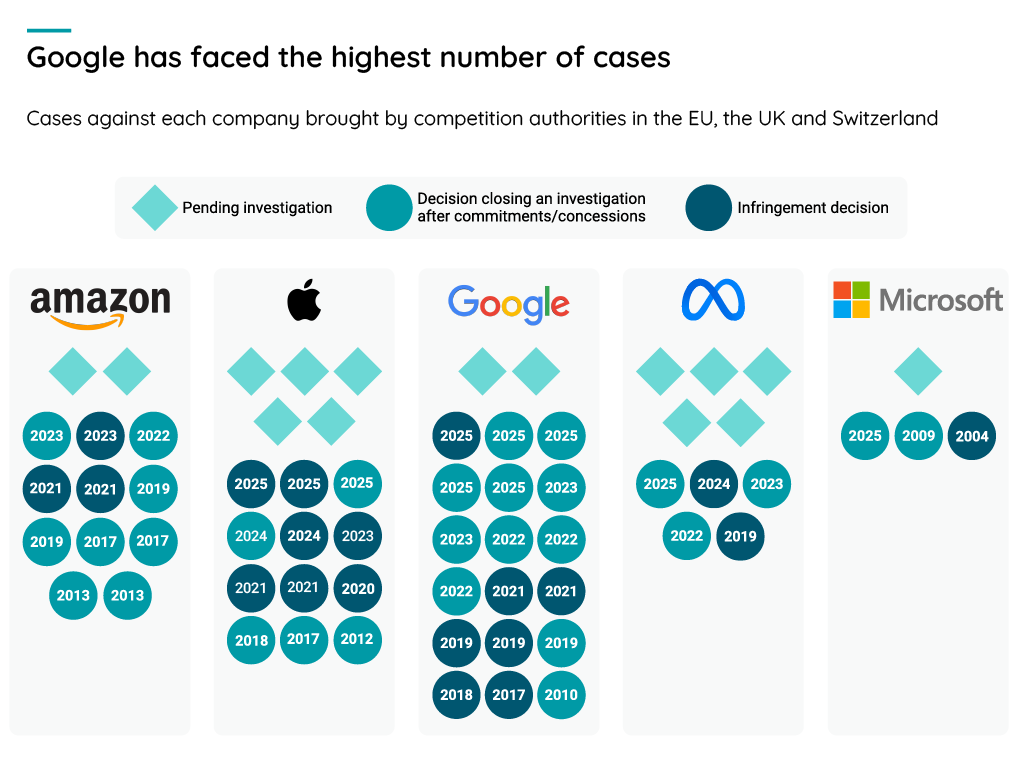
US big tech companies (Amazon, Apple, Google, Meta and Microsoft) are the targets of more than a dozen pending antitrust investigations in Europe, having previously received fines or made concessions in almost 50 past cases brought by the European Commission and national competition authorities.
These ex post antitrust cases are on top of the ex ante enforcement action against big tech companies under the EU Digital Markets Act (DMA).
Key takeaways
- Competition authorities in Europe have brought a total of over 60 antitrust cases against US big tech companies. Besides the European Commission, national authorities in France, Germany and Italy have been the most active competition enforcers.
- Even with many competition issues being addressed ex ante by the DMA, ex post antitrust enforcement did not slow down: 2025 saw a record number of antitrust decisions, including 5 infringement decisions and 5 settlements.
- Currently, there are two ongoing EU antitrust probes, which target Google and Meta for AI-related conduct. However, each big tech company also faces scrutiny at the national level, with national competition authorities running 13 investigations in total.
These findings are drawn from Cullen International’s latest report on past and pending antitrust cases against big tech companies in Europe.
The report provides an overview of all the cases brought under ex post antitrust rules at EU and national level, with most cases targeting alleged abuses of dominance. It links to detailed analytical case summaries in Cullen International’s Antitrust & Mergers Database.
Scope
Region: Europe
Countries covered: 30 (EU-27, Norway, UK, Switzerland)
Policy area: Competition
Last updated: January 2026
For more information and access to the report, click 'Access full content' – or 'Request access' if you are not yet a subscriber to our Antitrust & Mergers Service.
more news
09 October 26
Four LATAM countries address connectivity gaps
Cullen International’s latest LATAM Telecoms Update highlights policy developments over the past three months affecting the regulation of radio spectrum, wholesale networks and consumer protection in six markets in the region: Argentina, Brazil, Chile, Colombia, Mexico and Peru.
08 October 26
Many European countries consider banning minors from accessing social media
Cullen International has just published a new version of its benchmark which tracks the current debates/ initiatives on banning access to social media to protect minors online in Europe.
05 October 26
Ireland, the Netherlands and France account for the highest sum of data protection fines against large digital platforms
Our latest benchmark tracks fines imposed on large digital platforms by data protection and other supervisory authorities in 19 European countries since May 2018. It covers GDPR and e-Privacy Directive infringements and identifies whether the GDPR consistency mechanism was used in cross-border cases.