Cullen International’s latest benchmark on the modernisation of the universal service obligation (USO) found that, as declining letter volumes continue to undermine the financial sustainability of universal service providers, several countries have amended their USO legislation in recent years.
Denmark, Germany and Lithuania revised their USO in 2024 and 2025, with certain measures scheduled to enter into force in 2026.
In Lithuania, the new Postal Law introduces a revenue cap to replace the individual retail price cap as of 2026, with the methodologies still to be defined.
In July 2025, the UK introduced changes to the USO, focusing on delivery frequency and quality of service but for letters only. A consultation covering issues such as the safeguard cap on second-class letter prices will be launched in Q1 2026. The current price cap will remain in force until 31 March 2027.
Four countries have not amended their USO since 2010.
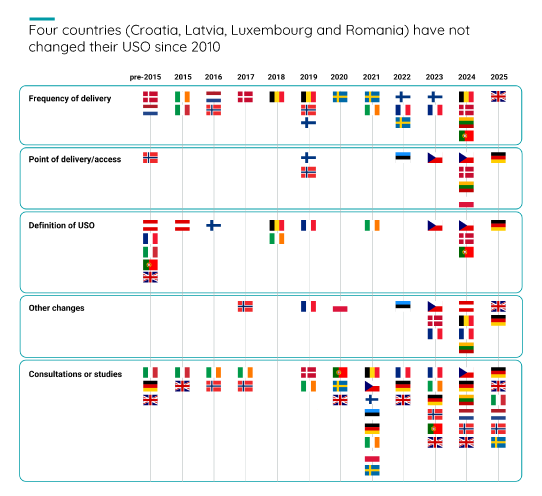
This benchmark presents information on the changes in USO specifications since 2010, including:
- the frequency of collection and delivery;
- the definition of the place of delivery (i.e. not to the letter box or premises);
- the location and availability of access points;
- the USO scope (such as removing services from the USO); and
- other changes.
The benchmark also lists consultations and studies launched to assess whether the current USO scope remains appropriate in light of market developments and evolving user needs.
For more details and for access to the full benchmark, please click on “Access the full content” - or on “Request Access”, in case you are not subscribed to our European Postal service.
more news
30 June 26
Transposition status of key EU environmental directives
Our latest benchmark contains summary information on the transposition status of six key EU environmental directives.
18 June 26
[INFOGRAPHIC] Cullen Cheat Sheet: M&A wave in Latin America’s telecoms sector
This Cullen International infographic highlights the key M&A transactions in the LATAM telecoms market in the last few years.
15 June 26
Global trends in regulating cross-border personal data transfers
Our latest Global Trends benchmark compares key aspects of the regulation of cross-border personal data transfers across 14 jurisdictions worldwide.