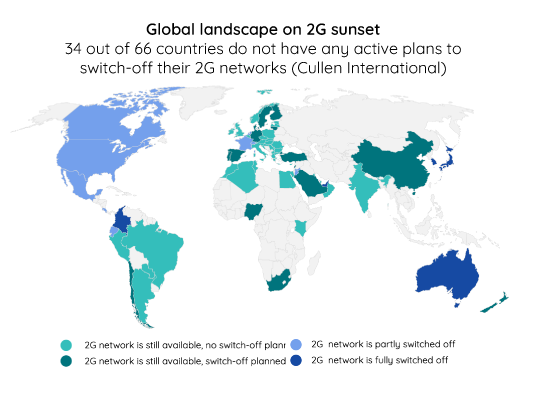
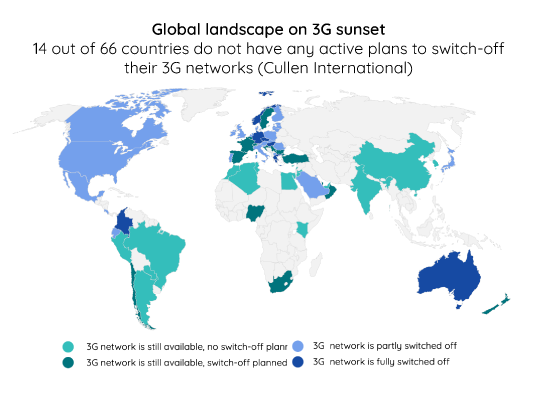
There is no consistent global approach to the switch-off of legacy (2G and 3G) mobile networks. The wide diversity in approaches and timing for switch-off poses a particular challenge for the ability of global IoT providers to maintain service continuity, roaming reliability, and device compatibility.
Cullen International’s IoT regulatory intelligence service provides a clear and comprehensive benchmark tracking the switch-off status of 2G and 3G networks in 66 countries across the world.
The benchmark covers:
- the operational status of 2G and 3G networks in each country;
- plans announced by operators and regulators to switch off 2G or 3G networks; and
- operators that have already decommissioned 2G or 3G services.
Key regional findings:
- Africa – Most countries still operate both 2G and 3G networks. However, phased shutdowns have begun in major markets like South Africa and Nigeria.
- Americas – The USA has fully shut down 2G and 3G networks, while Canada is also in the process of doing so. However, legacy networks remain active in Latin American countries, with no uniform timeline for future switch-off.
- Asia-Pacific – 2G has already been switched off in Australia, Japan, South Korea, and Singapore. 3G shutdowns are taking place or are scheduled in most markets, although China and India continue to operate both 2G and 3G networks.
- Europe – 3G is being phased out rapidly but 2G remains widely available, with many countries continuing to support it for IoT and M2M applications.
- Middle East – 2G has been decommissioned in the UAE and Bahrain. 3G shutdowns are underway or planned in Saudi Arabia, Kuwait, and Türkiye.
Why this matters for IoT providers
Cullen’s IoT service, of which this benchmark forms a part, delivers a unique overview of global regulatory developments relevant to IoT providers. Providers can use this intelligence to:
- anticipate connectivity risks for deployed devices;
- prioritise their activities in markets that have supportive frameworks; and
- adapt their product and connectivity strategies to align with national policies.
For more information and access to our research, click 'Access full content' – or 'Request access', if you are not yet a subscriber to our IoT service.
more news
04 November 26
In nine European countries, national symmetric obligations on access to ducts go beyond the scope set by the Gigabit Infrastructure Act
Cullen International's latest benchmark analyses asymmetric and symmetric duct access obligations in Europe.
04 November 26
More than 60 cases and counting: a snapshot of European antitrust enforcement against big tech
Cullen International’s latest report on past and pending antitrust cases against big tech companies in Europe tracks enforcement activity under ex post antitrust rules at EU and national level.
30 October 26
Many governments around the globe rely on legal mechanisms to compel communications apps to cooperate in law enforcement investigations
Cullen International's latest Global Trends benchmark for number-independent communications apps regulation found that nearly all of the 13 surveyed jurisdictions around the world provide some legal mechanism to make these apps assist law enforcement in criminal investigations. There are requirements to verify user identities, compel disclosure of stored content, make encrypted content accessible, and duties to detect illegal content within private communications.