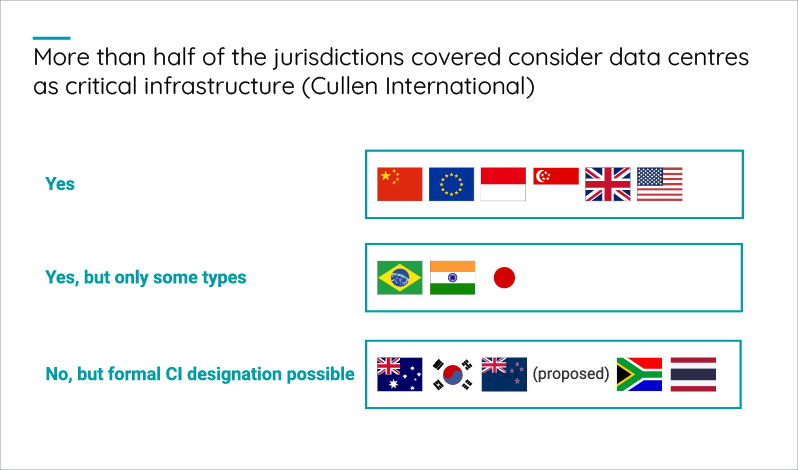
An updated Global Trends benchmark update shows there is diversity, among 14 jurisdictions around the world, in the policies and regulatory frameworks applicable to data centres and/or cloud service providers. Approaches tend to reflect different perceptions, at domestic level, of the opportunities and threats bound to the “cloudification” of all sectors of the economy along with increasing adoption of artificial intelligence (AI).
What the content covers
The benchmark analyses licensing and ownership rules, cloud-related competition policy, cybersecurity and certification requirements, government cloud policies, sovereign cloud initiatives and financial support for data centres and cloud service providers.
The benchmark covers Australia, Brazil, China, the EU, India, Indonesia, Japan, Korea, New Zealand, Singapore, South Africa, Thailand, the UK and the US.
Key findings
- Excluding planning or environmental permits, only China and Thailand require data centres and/or cloud service providers to obtain one or more national licences to offer their services.
- China and Thailand are also the only covered jurisdictions with quantitative thresholds on maximum foreign ownership for data centres, while most other jurisdictions rely on discretionary foreign investment review processes.
- Regulation of data centres and cloud services is increasingly linked to broader policy priorities, including digital competition, cybersecurity, sovereign cloud, AI infrastructure, sustainability and environmental impact.
Scope
Region: Global
Countries covered: 14 jurisdictions — Australia, Brazil, China, the EU, India, Indonesia, Japan, Korea, New Zealand, Singapore, South Africa, Thailand, the UK and the US
Policy area: Data centres, cloud services and digital infrastructure
Published: 30 July 2026
For more information and to access the full report, please click on "Access the full content" – or on "Request Access", in case you are not subscribed to the Global Trends service.
more news
21 August 26
Sustainability targets of car manufacturers
Our latest benchmark summarises the sustainability targets put in place by the major car manufacturers.
19 August 26
Regulating submarine cable infrastructure
Our latest Global Trends benchmark analyses policies and regulations of relevance to international submarine cables used for electronic communications in 17 jurisdictions around the world.
18 August 26
Countries around the world take different approaches to data centre development
Cullen International’s new benchmark provides insights into how 19 countries, including 13 in Europe, have introduced rules to incentivise and/or regulate the development of data centres.