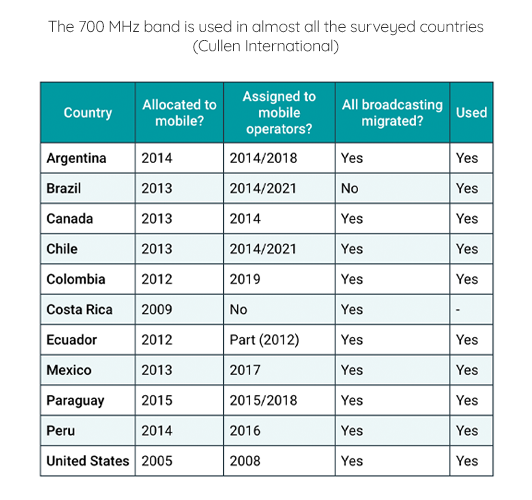
The status of the analogue switch-off (ASO) varies across countries but all North American countries have completed the ASO. The USA did so in 2009, Canada in 2011-2012 and Mexico at the end of 2015. Broadcasters with low-power stations were granted longer deadlines (or, in Canada, a permanent exemption).
In Latin America, Chile completed ASO in April 2024 and Costa Rica in January 2023. The Argentinian government postponed the final date for ASO until 2027, Brazil until June 2025, and, following several postponements, ASO in Paraguay is currently set to start in December 2024 and end in September 2029.
The deadline for ASO in Peru and Colombia is still undecided.
Costa Rica announced that it will award the 700 MHz spectrum for IMT by 2H 2024 but with the date of the auction still undecided.
To access the full benchmark, please click on “Access the full content” - or on “Request Access”, in case you are not subscribed to our Americas Spectrum service.
more news
04 November 26
In nine European countries, national symmetric obligations on access to ducts go beyond the scope set by the Gigabit Infrastructure Act
Cullen International's latest benchmark analyses asymmetric and symmetric duct access obligations in Europe.
04 November 26
More than 60 cases and counting: a snapshot of European antitrust enforcement against big tech
Cullen International’s latest report on past and pending antitrust cases against big tech companies in Europe tracks enforcement activity under ex post antitrust rules at EU and national level.
30 October 26
Many governments around the globe rely on legal mechanisms to compel communications apps to cooperate in law enforcement investigations
Cullen International's latest Global Trends benchmark for number-independent communications apps regulation found that nearly all of the 13 surveyed jurisdictions around the world provide some legal mechanism to make these apps assist law enforcement in criminal investigations. There are requirements to verify user identities, compel disclosure of stored content, make encrypted content accessible, and duties to detect illegal content within private communications.