Most countries in the Americas have a framework in place for penalising infringements of data protection laws.
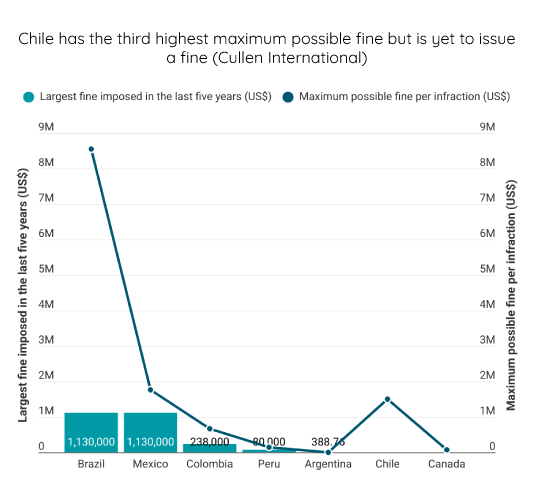
However, Cullen International’s latest research shows that the maximum possible fines per infraction and the largest fines imposed in the last five years vary significantly across the region.
While Brazil and Mexico have imposed the highest fines in the region at US$1.13m, Brazil’s maximum possible fine per infraction is significantly higher than Mexico’s and the highest in the region.
Chile and Canada have not imposed fines for data protection infringements during the period covered by our most recent research.
In contrast, while Europe also exhibits significant variation across countries, the fines for data protection infringements are significantly higher.
Most surveyed European countries recorded, individually, larger fines for data privacy violations than each of the surveyed countries in the Americas. The amount of the fines is usually significantly higher than even the maximum fines applicable by law in the countries surveyed in the Americas.
To access the full benchmark, please click on “Access the full content” - or on “Request Access”, in case you are not subscribed to our Americas Digital Economy service.
more news
15 October 26
Europe: national rules continue to shape cross-border IoT connectivity
Europe is often treated as a single market for IoT connectivity but, in practice, national rules on SIM registration, numbering and authorisation still differ between countries. Cullen International's latest benchmarks examine these rules across 31 European markets.
14 October 26
Regulators worldwide take several distinct approaches to legally defining communications apps, authorise their operation and govern their interoperability
Cullen International's latest Global Trends benchmark for communications apps regulation found diverse regulatory approaches to the legal definition, licensing and interoperability of number-independent communications apps. The benchmark addresses regulation of apps such as WhatsApp, WeChat and iMessage across 13 jurisdictions around the world.
13 October 26
Almost half of surveyed countries in the Americas have commercial D2D satellite services
Cullen International’s latest Benchmark compares the regulatory conditions for D2D satellite services using terrestrial IMT spectrum across 12 countries in the Americas.