Cullen International has just published a new benchmark showing in thirteen selected countries if there are specific legislative/regulatory initiatives to regulate online influencers. It also shows who is targeted by the initiative(s) (i.e. influencers above some criteria/ thresholds) and gives a brief explanation of the measures foreseen.
Influencers might fall under the scope of several EU pieces of legislation, such as the consumer protection legislation and the Audiovisual Media Services (AVMS) Directive.
In its conclusions of 14 May 2024, the Council encourages the Commission and the member states to explore ways to support influencers at EU level, including via a coherent policy approach focusing on media literacy and responsible online behaviour. It also invites the Commission and the member states to develop policies to support the development of self-regulatory bodies or mechanisms (including a possible ethical code), and to consider the effects of the increased use of artificial intelligence (AI) by influencers and the implementation of labelling requirements according to the AI Act.
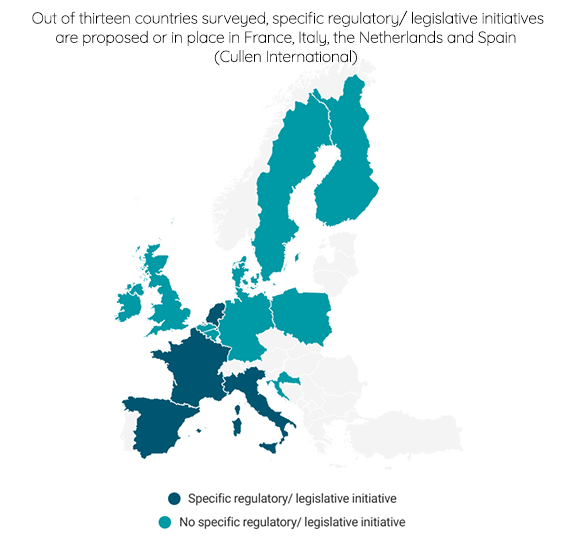
The benchmark shows that four out of the thirteen countries surveyed have specific regulatory/legislative initiatives proposed or in place (France, Italy, the Netherlands and Spain).
In Germany, influencers are already covered by existing laws stemming from the AVMS Directive and guidelines adopted by the Lander authorities.
For more information and access to the benchmark, please click on “Access the full content” - or on “Request Access”, in case you are not subscribed to our European Media service.
more news
15 September 26
[INFOGRAPHIC] Cullen cheat sheet: AI Act Timeline
Our new timeline outlines the milestones in the implementation of the Artificial Intelligence Act (AI Act) until August 2031.
11 September 26
Have EU countries implemented the e-Evidence Package?
Cullen International’s latest Benchmark tracks implementation of the e-Evidence Regulation and transposition of the accompanying Directive on legal representatives across 26 EU member states.
10 September 26
Digital Networks Act recitals now directly linked to articles in the Cullen Legislation Navigator
Digital Networks Act (DNA) recitals now link to articles in Cullen international's Legislation Navigator online tool.