Spectrum regulations in the Americas normally allow for the renewal of spectrum licences but subject to specific rules set out by the national regulator.
In 2023, several countries are granting licence extensions and renewals. Brazil renewed until 2038 the 1900–2100 MHz band licences of Algar, Claro, TIM, and Vivo. Paraguay renewed Nucleo’s licence in the 850 MHz band until 2028, whereas the Ecuadorean regulator decided to extend Claro’s spectrum licences in the 850 MHz, 1900 MHz and AWS bands for only six months while analysing a further renewal. Colombia is working on the renewal of several licences that will expire in 2023, including licences in the 1900 MHz, AWS and 2.6 GHz bands.
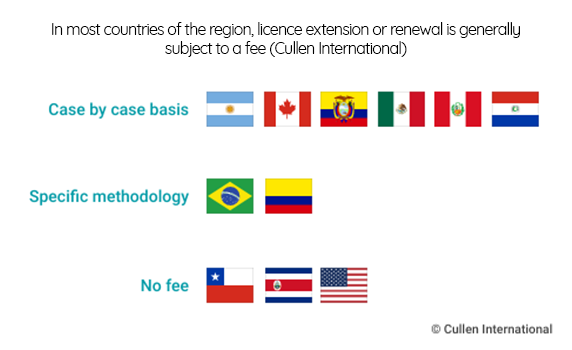
In most countries of the region, licence extension or renewal is generally subject to a fee. Argentina, Canada, Ecuador, Mexico, Paraguay and Peru set renewal fees on a case-by-case basis, while Brazil, and Colombia defined a specific calculation methodology. Chile, Costa Rica and the United States do not impose renewal fees on operators.
In Costa Rica and Ecuador, the state-owned mobile operators originally received spectrum licences for an indefinite duration. However, in Ecuador, the new Telecommunications Law of 2015 and the concession regulation of 2016 modified the expiration term to 20 years. In Argentina, the first mobile licences were granted for an indefinite term, but the new spectrum licences granted in 2014 and to be granted during 2023 have a 15 and 20 year term, respectively.
Cullen International’s latest research details the general spectrum licence renewal framework, the approach chosen in each country for licence renewal, the renewal fees, and examples of the latest renewals and extensions.
To access the full benchmark, please click on “Access the full content” - or on “Request Access”, in case you are not subscribed to our Americas Spectrum service.
more news
04 November 26
In nine European countries, national symmetric obligations on access to ducts go beyond the scope set by the Gigabit Infrastructure Act
Cullen International's latest benchmark analyses asymmetric and symmetric duct access obligations in Europe.
04 November 26
More than 60 cases and counting: a snapshot of European antitrust enforcement against big tech
Cullen International’s latest report on past and pending antitrust cases against big tech companies in Europe tracks enforcement activity under ex post antitrust rules at EU and national level.
30 October 26
Many governments around the globe rely on legal mechanisms to compel communications apps to cooperate in law enforcement investigations
Cullen International's latest Global Trends benchmark for number-independent communications apps regulation found that nearly all of the 13 surveyed jurisdictions around the world provide some legal mechanism to make these apps assist law enforcement in criminal investigations. There are requirements to verify user identities, compel disclosure of stored content, make encrypted content accessible, and duties to detect illegal content within private communications.