Cullen International’s European spectrum database now covers spectrum licences and spectrum award procedures in the mobile bands in 33 European countries. It can be accessed by country and by band.
The following chart, derived from the database, shows the national (dark) and regional (light) licences issued in three groups of EU harmonised bands.
- <1 GHz: 700 MHz (2x30 + 20 MHz), 800 MHz (2x30 MHz), 900 MHz (2x35 MHz): 210 MHz in total
- 1–3 GHz: 1500 MHz (90 MHz), 1800 MHz (2x75 MHz), 2.1 GHz paired (2x60 MHz), 2.6 GHz (2x70 + 50 MHz): 550 MHz in total
- 3–6 GHz: 3.5 GHz band (400 MHz): 400 MHz in total
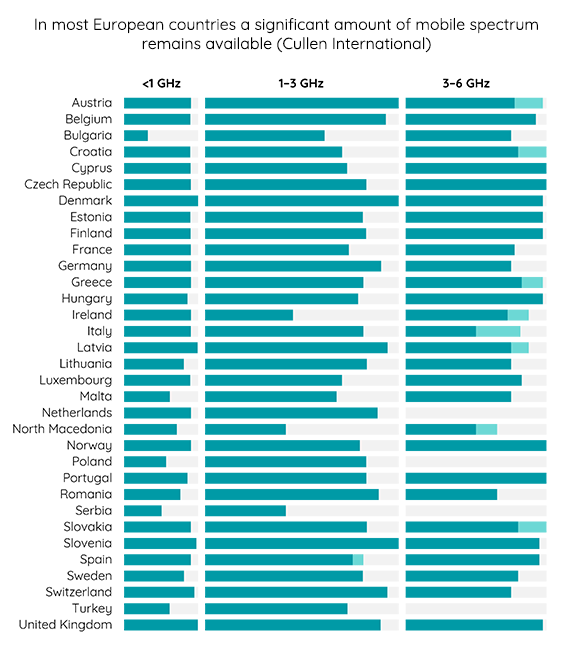
The Spectrum Database also contains licences in the 450 MHz band, the unpaired 2.1 GHz band and the 2.3 GHz band. These are not included in the chart because they are not (or are no longer) harmonised at EU level.
The Spectrum Database also contains licences in the 26 GHz band, which were not included in the chart because the band is so wide (3250 MHz) that it would distort the figure.
European Commission decisions on spectrum harmonisation are only binding for the 27 EU member states. The Spectrum Database also covers North Macedonia, Norway, Serbia, Switzerland, Turkey and the United Kingdom.
For more information and a free demo of the database, please click on “Request Access”, or on "Access the full content” in case you are subscribed to our European Spectrum Service.
more news
20 May 26
Spectrum sharing in Europe
Spectrum is a scarce resource and can be used more efficiently when multiple users agree to share it. Cullen International designed two new benchmarks that examine the regulation and practice of spectrum sharing in 21 European countries.
13 May 26
Protection of minors: national rules to protect minors from exposure to pornographic content in Europe
Our latest benchmark shows the initiatives proposed or in place in selected European countries to control or restrict the exposure of minors to online pornographic content.
12 May 26
Some EU member states pre-empt EU level small parcel handling fee
Our new benchmark shows whether EU member states are applying a specific small parcel handling fee, compares fee levels, the legal basis, collection mechanisms, and implementation status.