Cullen International has just published a new benchmark with an overview of the countries which have adopted (or are in the process of adopting) legislation to fight against the dissemination of illegal content on social media/ online platforms.
In countries which have adopted (or are in the process of adopting) initiatives, the benchmark shows the type of illegal content covered and the type of platforms targeted (i.e. social media, search engines, etc.), the main obligations imposed on them, the sanctions foreseen in case of non-compliance and the special powers granted to the authority in charge of supervision (e.g. fines and blocking orders).
The research shows that four countries out of the 14 surveyed have rules in place (France, Germany), or are in the process of adopting rules (Ireland, UK) to fight against the dissemination of illegal content on platforms. In France and Germany, the rules cover certain types of illegal content as defined under the criminal code (and the legislation on the freedom of the press in France), whereas in the UK and in Ireland, the proposed legislation has a much wider scope as it covers many types of illegal and harmful content (such as pornography or content that can lead to eating disorders).
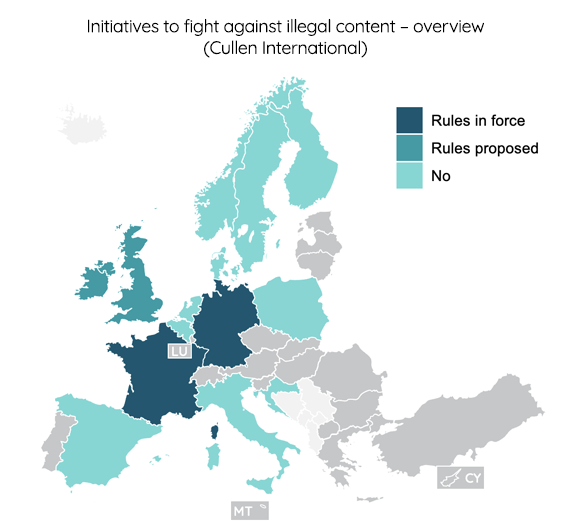
There is no general initiative to address illegal content in the other countries. In Italy, targeted initiatives exist to fight specific types of illegal content, such as cyberbullying and revenge porn. In Belgium (Wallonia), the regulator published an orientation note which underlines the impact of illicit content on online platforms and the inadequacy of the current regulation.
To access the full benchmark, please click on “Access the full content” - or on “Request Access”, in case you are not subscribed to our European Media service.
more news
20 May 26
Spectrum sharing in Europe
Spectrum is a scarce resource and can be used more efficiently when multiple users agree to share it. Cullen International designed two new benchmarks that examine the regulation and practice of spectrum sharing in 21 European countries.
13 May 26
Protection of minors: national rules to protect minors from exposure to pornographic content in Europe
Our latest benchmark shows the initiatives proposed or in place in selected European countries to control or restrict the exposure of minors to online pornographic content.
12 May 26
Some EU member states pre-empt EU level small parcel handling fee
Our new benchmark shows whether EU member states are applying a specific small parcel handling fee, compares fee levels, the legal basis, collection mechanisms, and implementation status.