Austria started the legislative process to transpose the Corporate Sustainability Reporting Directive (CSRD) into its national law in November 2025. The CSRD requires all large companies to publish regular reports on their environmental and social impact activities. The directive defines a common reporting framework for non-financial data, which aims to ensure that businesses report reliable and comparable sustainability information.
Seven member states are still transposing the CSRD, having missed the 6 July 2024 transposition deadline. The Commission has issued formal infringement notice letters to 17 member states for their failure to transpose the CSRD fully. The infringement proceedings are still pending.
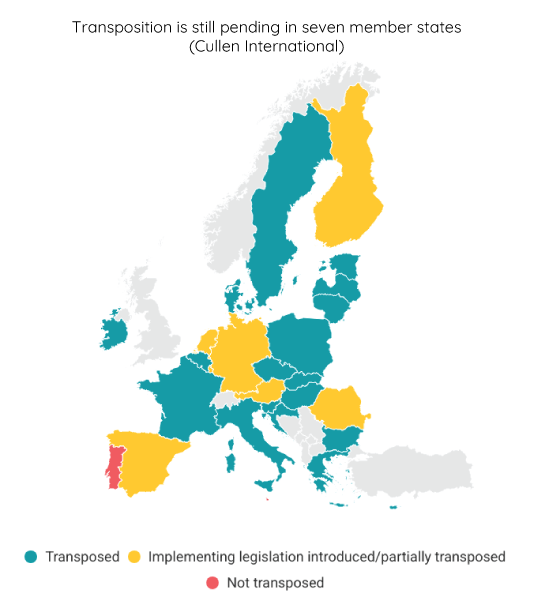
The Commission decided to postpone the application of the CSRD by one year for large enterprises, parents of large enterprises and SMEs with securities listed in the EU. The CSRD amendment was implemented through the Omnibus I ("stop-the-clock") directive, which member states must transpose into their national legislation by 31 December 2025.
Four more member states (Belgium, Denmark, Finland and Slovenia) have transposed the “stop-the-clock” directive since Cullen’s September update.
Cullen International’s updated benchmark tracks the progress made by the 27 EU member states in transposing the CSRD and the related “stop-the-clock” directive.
For more information on the benchmark and Cullen's complete CSRD coverage, please click on “Access the full content” - or on “Request Access”, in case you are not subscribed to our Sustainability service.
more news
20 October 26
What European spectrum regulators do when licences are about to expire
Cullen International’s latest European Benchmark shows that 10 of the 21 studied countries have a general policy of organising a new auction whenever spectrum licences expire.
19 October 26
[INFOGRAPHIC] Cullen cheat sheet on the European Commission’s proposal for an EU Kids Act
New Cullen International cheat sheet on the EU Kids Act proposal.
15 October 26
Europe: national rules continue to shape cross-border IoT connectivity
Europe is often treated as a single market for IoT connectivity but, in practice, national rules on SIM registration, numbering and authorisation still differ between countries. Cullen International's latest benchmarks examine these rules across 31 European markets.