EU member states had to transpose the European Electronic Communications Code (EECC) into national law by 21 December 2020.
At that deadline, four EU member states (Denmark, Finland, Greece and Hungary), as well as the UK, had fully transposed the EECC.
Infringement proceedings
The European Commission announced the second stage of infringements proceedings, in the form of a reasoned opinion, against 18 member states on 21 September 2021.
The Commission had in February 2021 already sent letters of formal notice to 24 member states, the first stage of an infringement proceeding, asking member states to adopt and notify their national transposition measures.
Transposition status
Cullen International's benchmark tracks member states' progress, including details on:
- current status (where "transposed" indicates that a member state has completed the adoption of their EECC transposition laws);
- treatment of legislation in national parliaments; and
- final adoption and entry into force.
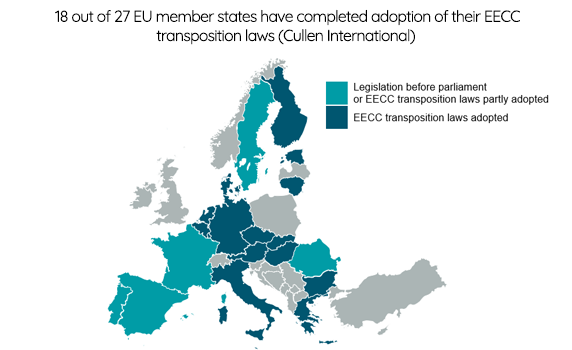
For more information or access to the full benchmark, please click on “Access the full content” - or on “Request Access”, in case you are not subscribed to our European Telecoms service.
more news
03 April 26
Spectrum policy and new consumer protection rules in the LATAM telecoms market
Cullen International’s latest LATAM Telecoms Update highlights policy developments over the past three months affecting the regulation of radio spectrum, wholesale networks and consumer protection in six markets in the region: Argentina, Brazil, Chile, Colombia, Mexico and Peru.
30 March 26
Transposition status of key EU environmental directives
Our latest benchmark contains summary information on the transposition status of six key EU environmental directives.
26 March 26
What are New Competition Tools and who wields them?
Our new benchmark surveys which European countries have introduced so-called new competition tools (NCTs), also known as market investigation powers. NCTs enable competition authorities to intervene in markets without establishing an infringement of antitrust rules.