Cullen International’s new benchmark shows that data protection authorities in half of the 16 surveyed European countries imposed fines on big tech companies for either General Data Protection Regulation (GDPR) or e‑Privacy Directive (ePD) infringements since the entry into application of the GDPR in May 2018.
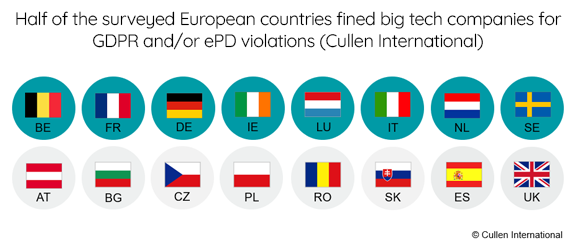
The benchmark shows that Luxembourg is the country with the highest sum of fines imposed with €746m, followed by Ireland and France.
Amazon, WhatsApp and Google are the big tech companies which incurred in the highest sum of fines at €781m, €225m and €155.7m respectively.
The benchmark also looks at whether, in the event of GDPR infringement in multiple EU member states, big tech companies benefitted from the cooperation and consistency mechanism introduced by the GDPR. The mechanism aims to achieve the consistent application of the GDPR throughout the EU.
For more information and access to the benchmark, please click on “Access the full content” - or on “Request Access”, in case you are not subscribed to our European Digital Economy service.
more news
21 October 26
Around the world, many regulators examined communications apps through distinct lenses, but their interventions did not always lead to any enforcement
Cullen International's latest Global Trends benchmark for communications apps regulation shows how telecoms, consumer protection, data protection and competition regulators intervene in the number-independent communications apps sector. The benchmark addresses regulation apps such as WhatsApp, WeChat and iMessage across 13 jurisdictions around the world.
20 October 26
What European spectrum regulators do when licences are about to expire
Cullen International’s latest European Benchmark shows that 10 of the 21 studied countries have a general policy of organising a new auction whenever spectrum licences expire.
19 October 26
[INFOGRAPHIC] Cullen cheat sheet on the European Commission’s proposal for an EU Kids Act
New Cullen International cheat sheet on the EU Kids Act proposal.