The European Commission presented on 21 April 2021 its long-awaited proposal to regulate the use of artificial intelligence (AI) in Europe. The proposed regulation builds on the Commission white paper on AI from February 2020 and is accompanied by a new Coordinated plan which envisages joint actions for the Commission and the EU member states to boost the uptake of AI.
Cullen International provides an in-depth analysis of the proposed AI regulation, which would be directly applicable in EU countries once it enters into force.
The proposed framework would lay down harmonised rules for “the placing on the market, the putting into service and the use of” AI systems in the EU. It offers a risk-based approach with four levels of risk which serves as a reference point for the envisaged rules and obligations.
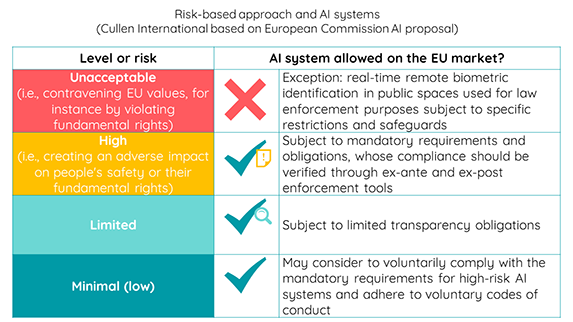
While certain AI practices would be prohibited, at the core of the proposed framework are high-risk AI systems which would be subject to specific mandatory requirements as well ex-ante conformity assessment.
The proposed regulation would establish governance systems at a national and an EU level (through a new European Artificial Intelligence Board), as well as rules on post market monitoring and penalties for non-compliance.
The analysis by Cullen International investigates the overall context of the proposed AI framework, the scope of obligations and requirements as well as the envisaged enforcement mechanisms.
For more information and access to the full analysis, please click on “Access the full content” - or on “Request Access”, in case you are not subscribed to our European Digital Economy Service.
more news
15 October 26
Europe: national rules continue to shape cross-border IoT connectivity
Europe is often treated as a single market for IoT connectivity but, in practice, national rules on SIM registration, numbering and authorisation still differ between countries. Cullen International's latest benchmarks examine these rules across 31 European markets.
14 October 26
Regulators worldwide take several distinct approaches to legally defining communications apps, authorise their operation and govern their interoperability
Cullen International's latest Global Trends benchmark for communications apps regulation found diverse regulatory approaches to the legal definition, licensing and interoperability of number-independent communications apps. The benchmark addresses regulation of apps such as WhatsApp, WeChat and iMessage across 13 jurisdictions around the world.
13 October 26
Almost half of surveyed countries in the Americas have commercial D2D satellite services
Cullen International’s latest Benchmark compares the regulatory conditions for D2D satellite services using terrestrial IMT spectrum across 12 countries in the Americas.