The European Commission has proposed an ambitious set of new rules to regulate digital services and very large platforms in the European Union.
The proposed Digital Services Act (DSA) aims to set common but tailored obligations and accountability rules for providers of network infrastructure (such as Internet access providers), hosting service providers, and in particular for online platforms (i.e. online marketplaces and social media platforms).
These new rules would cover providers that provide services in the union, even if they are not established in the EU. For the first time, full-fledged oversight and enforcement rules are envisaged with the ability to set fines of up to 6% of the global annual turnover of platforms.
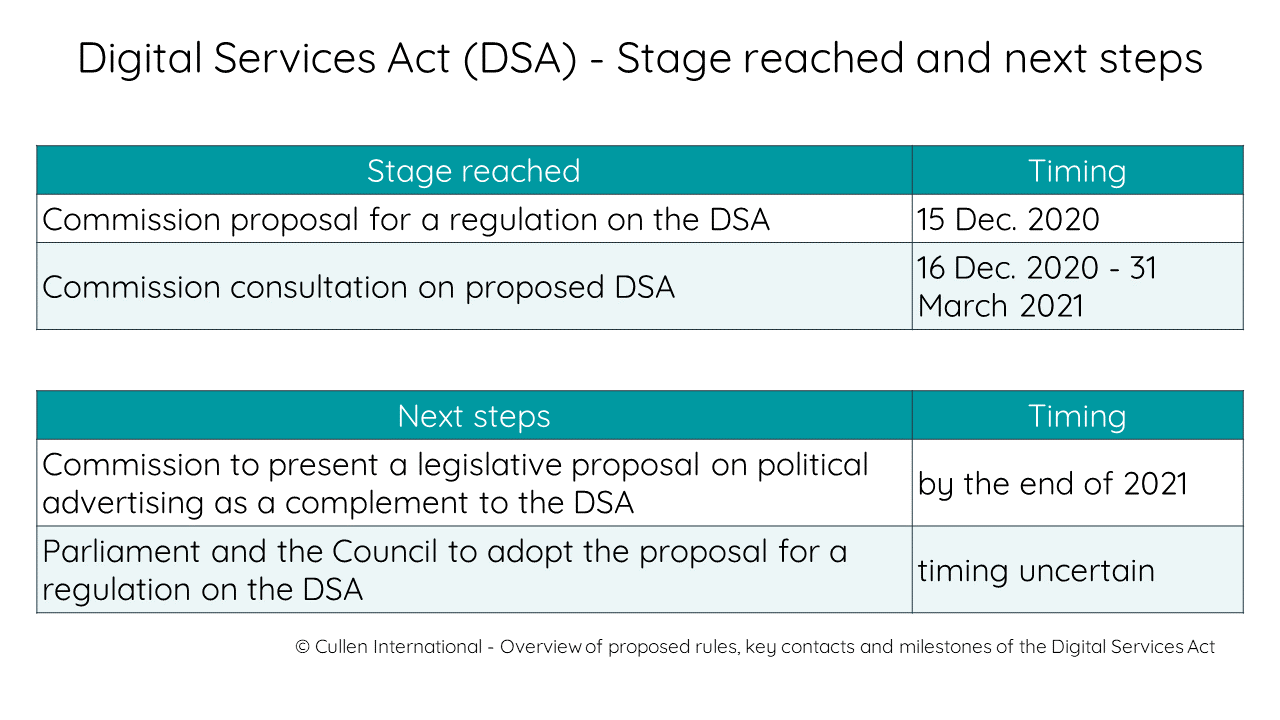
Cullen International just published a new ‘Tracker’, which provides a handy overview of the new proposed rules, the key contacts and the milestones. It will be updated every month with all the important developments as the DSA is scrutinised and amended by EU Parliament and Council.
To access the full report, please click on “Access the full content” - or on “Request Access”, in case you are not subscribed to our European Media service.
more news
23 September 26
Eleven surveyed Americas countries allow mobile satellite services in the 2 GHz band
Cullen International's latest Spectrum Benchmark compares 2 GHz spectrum allocations across 12 countries in the Americas, including permitted satellite uses, terrestrial use, spectrum assignments and recent regulatory developments.
21 September 26
EU Kids Act: EU Commission unveils gradual and differentiated approach to protect children online, including a social media delay
As announced by EU Commissioner Von der Leyen in her State of the Union address, the EU Commission unveiled a gradual and differentiated approach to protect children online, where “each age benefits from a tailored protection level”. Read our full analysis.
18 September 26
EU Timeline: regulatory milestones for the remainder of 2026
This edition of Cullen International’s EU Timeline highlights key policy and regulatory developments foreseen at EU level until the end of 2026.