Cullen International has published a new benchmark on national strategies and legislation on automated vehicles. The benchmark shows the different policy and regulatory aspects relevant for the development of automated cars in 11 selected European countries.
In particular, the new benchmark shows whether the researched countries have:
- developed a national strategy on automated vehicles;
- set a timeline for the deployment of automated vehicles;
- allowed the testing of automated vehicles on public roads or are conducting pilot projects;
- adopted specific civil liability regimes for automated vehicles; and
- imposed specific cybersecurity requirements for automated vehicles.
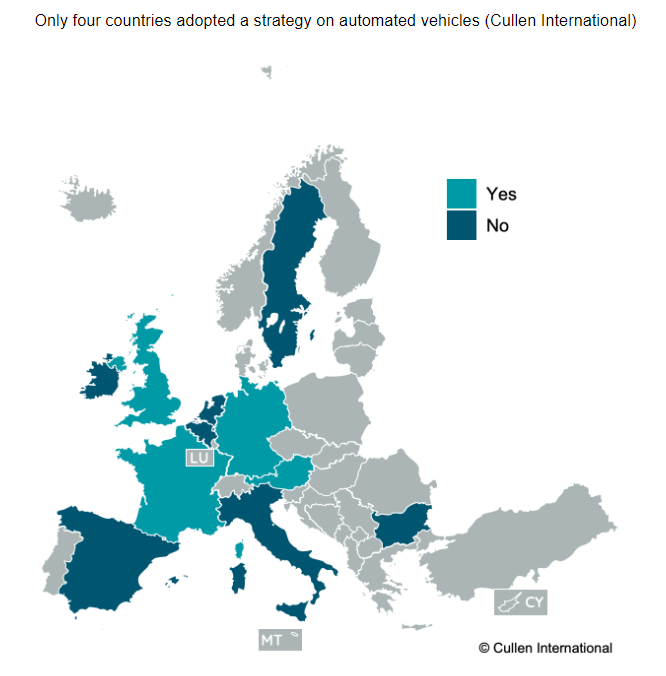
Our research reveals that only Austria, France, Germany and the UK of the 11 researched countries adopted a strategy on automated vehicles. View map
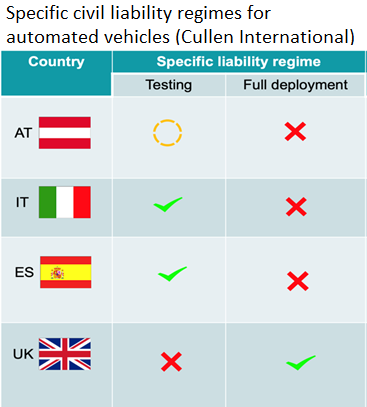
In addition, the research shows that, of the eleven countries researched, civil liability regimes for testing or full deployment of automated vehicles exist only in Italy, Spain and UK. View overview
To access the full benchmark, please click on “Access the full content” - or on “Request Access”, in case you are not subscribed to our European Digital Economy service.
more news
13 February 26
Compensation for network outages mandated in 11 EU countries
Our latest benchmark shows whether, in selected European countries, the law or the national regulator imposes an obligation on fixed and/or mobile operators to compensate their customers when their voice or data networks fail.
11 February 26
Connected car services – when OEM connectivity triggers EU telecoms rules
Our new Explainer analyses connected car business models in relation to the EU’s EECC framework and the Open Internet Regulation, explaining how different models may be classified as internet access services, interpersonal communication services, and services consisting wholly or mainly in the conveyance of signals.
11 February 26
The DNA explained: more leeway for NRAs to impose symmetric access
Cullen International is issuing a series of analyses on different aspects of the Digital Networks Act (DNA) proposal. This report covers the symmetric access rules.