Digital identity (ID) systems are becoming key enablers of digital economies and public service delivery, supporting access to government services, financial services and online platforms.
This global trend report explores the diversity of approaches worldwide, with governance models ranging from government-led to market-driven and hybrid frameworks. Digital ID systems also vary in scope, from those designed to support access across multiple services and sectors to those tailored for specific purposes or contexts. Architectures also differ, including centralised, federated and decentralised models, each involving trade-offs in interoperability, user control, scalability and trust.
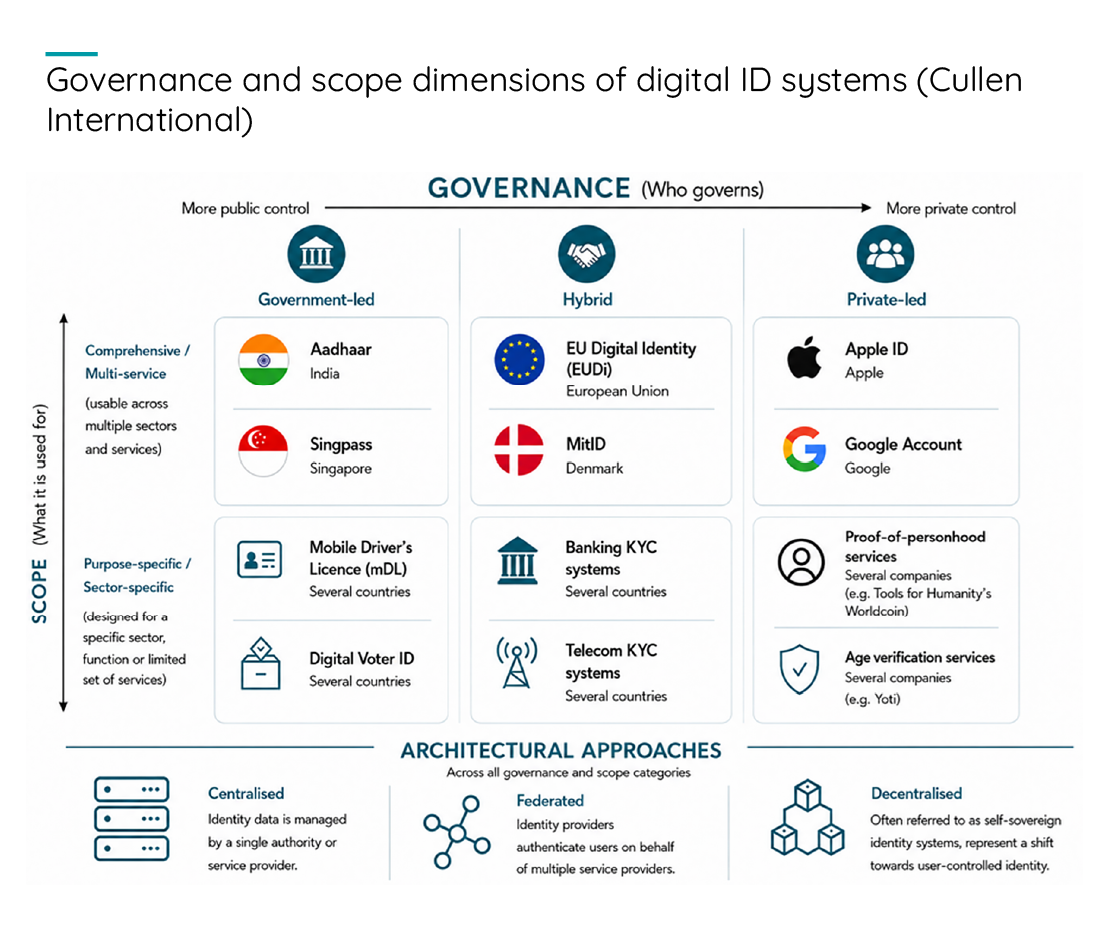
Policymakers are increasingly addressing risks related to exclusion, biometric governance, cybersecurity, vendor dependency and long-term sustainability.
The report highlights digital ID developments in eight jurisdictions, including Brazil, the EU, India, Kenya, Malaysia, Singapore, the UK and the US. The regulation of ID systems remains fragmented, with most jurisdictions relying on a mix of digital government, cybersecurity, data protection and sector-specific rules rather than a single framework.
Digital ID systems are also expanding beyond traditional authentication functions. Key trends include cross-border interoperability, expanded age-verification requirements, and stronger digital identity tools to combat fraud and impersonation. Interest is also growing in proof-of-personhood solutions that can distinguish humans from AI agents and bots.
For more information and to read the report, please click on “Access the full content” - or on “Request Access”, in case you are not subscribed to our Global Trends service.
more news
30 June 26
Transposition status of key EU environmental directives
Our latest benchmark contains summary information on the transposition status of six key EU environmental directives.
18 June 26
[INFOGRAPHIC] Cullen Cheat Sheet: M&A wave in Latin America’s telecoms sector
This Cullen International infographic highlights the key M&A transactions in the LATAM telecoms market in the last few years.
15 June 26
Global trends in regulating cross-border personal data transfers
Our latest Global Trends benchmark compares key aspects of the regulation of cross-border personal data transfers across 14 jurisdictions worldwide.