Cullen International’s latest benchmark shows measures in place in 13 European countries to ensure that end users are aware of their consumption behaviour and protected against bill shock.
Our research shows that, where services are billed based on either time or volume consumption, operators in all the countries studied must:
- offer end users a facility to monitor and control their usage, and
- notify end users when a specific consumption limit is reached.
Only four countries (Ireland, Poland, Spain, Sweden) require operators to offer end users a free option to stop access to premium rate services (PRS) once a specific usage limit has been reached. However, consumers in most countries may request PRS barring regardless of any specific limit.
Operators must inform end users of the most advantageous offer at least one month before the contract’s automatic renewal. The obligation to provide guidance on the best tariff option then applies every year, on the anniversary date of the contract.
Although this rule has been adopted in all the countries studied, only three national regulatory authorities have published guidance on how to calculate the best tariff plan.
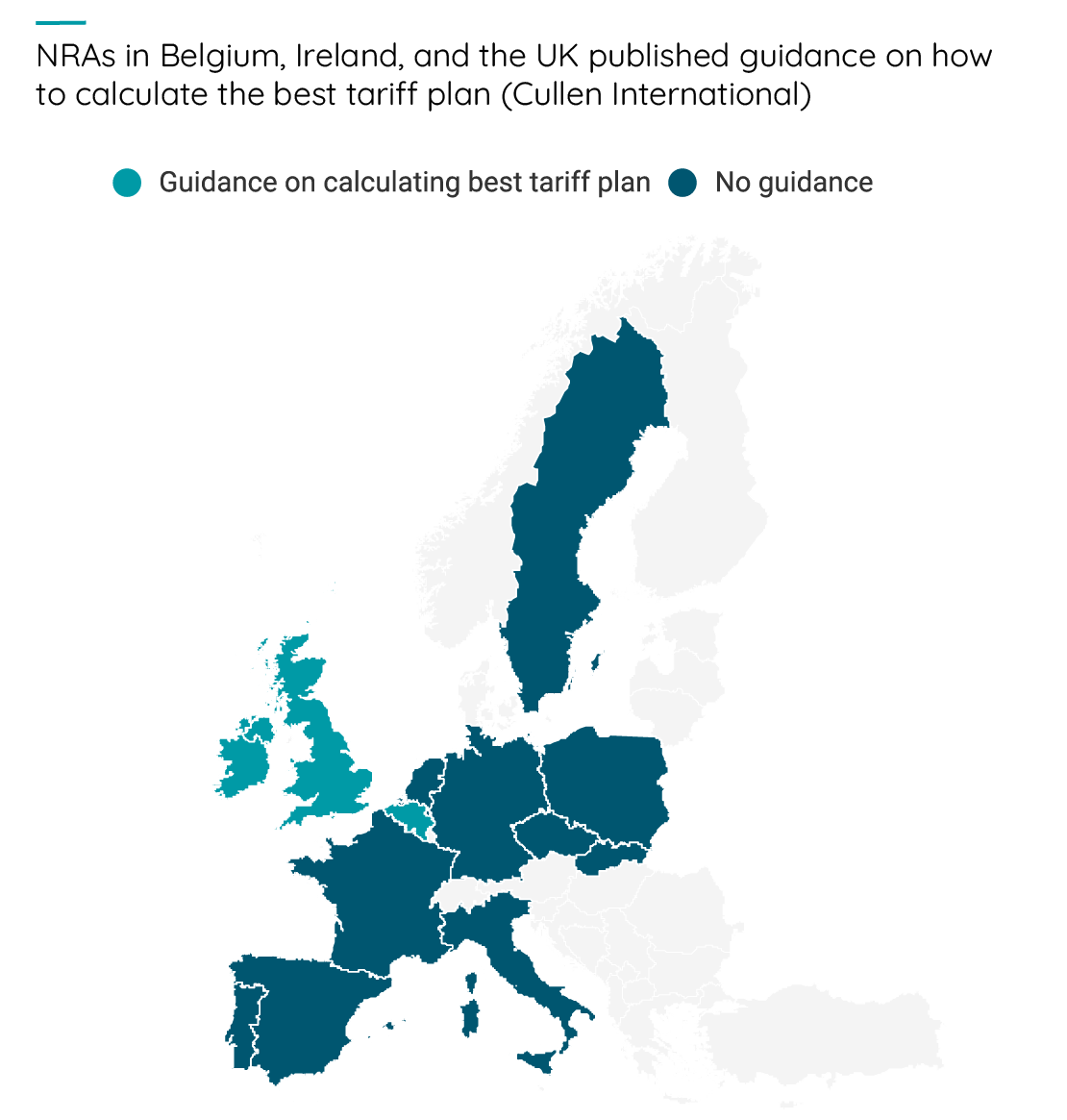
Cullen International notes that, under the proposed Digital Networks Act (DNA), the European Commission suggests removing the requirement for an annual best tariff advice. The draft DNA only maintains the obligation before the contract is automatically renewed.
Scope
Region: Europe
Countries covered: 13 (Belgium, Czech Republic, France, Germany, Ireland, Italy, Netherlands, Poland, Portugal, Slovakia, Spain, Sweden, UK)
Policy area: Consumer protection, retail regulation, expenditure control
Last updated: March 2026
For more information and access to the benchmark, please click on “Access the full content” - or on “Request Access”, in case you are not subscribed to our European Consumer Protection (in Telecoms) service.
more news
13 May 26
Protection of minors: national rules to protect minors from exposure to pornographic content in Europe
Our latest benchmark shows the initiatives proposed or in place in selected European countries to control or restrict the exposure of minors to online pornographic content.
12 May 26
Some EU member states pre-empt EU level small parcel handling fee
Our new benchmark shows whether EU member states are applying a specific small parcel handling fee, compares fee levels, the legal basis, collection mechanisms, and implementation status.
08 May 26
Global trends in quantum technology
Our latest Global Trends benchmark provides an overview of “who is doing what” in quantum technology in 16 jurisdictions around the world.