Cullen International’s new Benchmark shows that Brazil is the only country among those surveyed in the Americas to have proposed legislative changes that would specifically target the market power of online platforms. In September 2025, the government presented a bill that would allow the competition authority to impose ex ante remedies on companies with “systemic relevance” in digital markets to protect competition.
In other surveyed countries, interventions continue to rely on existing competition law provisions that apply across all sectors.
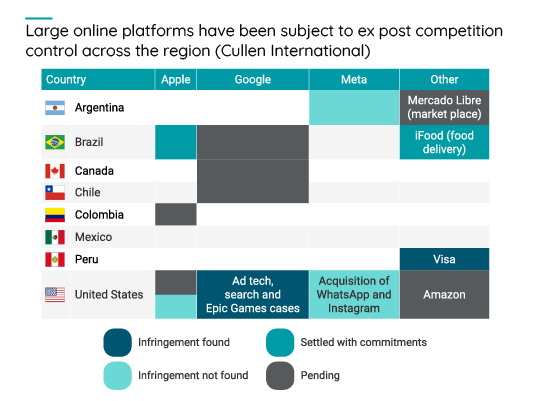
Over the past five years, all surveyed countries investigated or brought formal proceedings against suspected anticompetitive behaviour or mergers involving online platforms.
Apple, Google and Meta have faced several investigations by competition authorities. The outcomes of these cases have been mixed, and many final decisions are still pending.
 Scope
Scope
Region: Americas
Countries covered: 8 (Argentina, Brazil, Canada, Chile, Colombia, Mexico, Peru, United States)
Policy area: Competition, online platforms
Last updated: March 2026
For more information on the benchmark, please click on “Access the full content” - or on “Request Access”, in case you are not subscribed to our Americas Digital Economy service.
more news
28 May 26
Open RAN adoption remains limited to select markets
Our latest global trends benchmark on the adoption of open radio access network (open RAN) architecture covers commercial deployments, policy support and the emerging AI-RAN trend.
27 May 26
Inconsistent reporting hampers assessment of postal sector’s environmental performance
Our new report, from Cullen International’s recently launched Transport & Delivery Sustainability service, details how postal service providers currently report on their environmental performance.
20 May 26
Spectrum sharing in Europe
Spectrum is a scarce resource and can be used more efficiently when multiple users agree to share it. Cullen International designed two new benchmarks that examine the regulation and practice of spectrum sharing in 21 European countries.