A complex geopolitical climate
2026 started with increased geopolitical and trade tensions. The International Monetary Fund (IMF) observed in its 2026 World Economic Outlook that the global economy is “steady despite diverging forces.” However, the IMF also commented that “key downside risks [in the world economy] are re-evaluation of technology expectations and escalation of geopolitical tensions.”
In 2026 the health of democracies will also be tested in elections in many parts of the world. In the American continent alone, there will be elections in Brazil, some provinces in Canada, Colombia, Costa Rica, Peru, and in the US. Bangladesh, Denmark, Israel, Morocco, Sweden, Thailand and Uganda are only some of the many other countries around the world where citizens will be called to cast their votes in national elections.
What trends in global digital policies and regulations?
The geopolitical climate of 2026 will likely influence public policies for infrastructure for digital connectivity, data-based services and the online platform economy in all parts of the world. This Global Trends report aims to briefly comment on such trends.
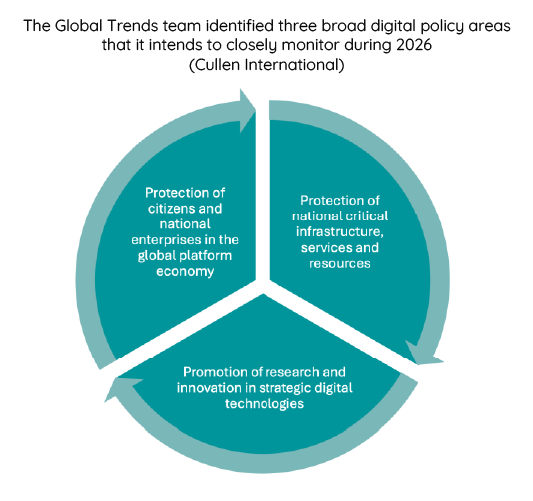
For more information and to read the full report, please click on “Access the full content” - or on “Request full report”, in case you are not subscribed to our Global Trends service.
You are also welcome to attend our upcoming webinar on this topic.
more news
17 September 26
Electric power backup and other redundancy requirements for telecoms operators across Europe
Our latest European Benchmark explores electric power backup and other redundancy requirements for mobile network operators to ensure service continuity during power outages, natural disasters, and other events impacting the operation of telecoms networks.
16 September 26
Mobile public warning systems (PWS) in the Americas
Cullen International’s new benchmark shows that public warning systems (PWS) are operational or being implemented in most of the 12 surveyed Americas countries.
15 September 26
[INFOGRAPHIC] Cullen cheat sheet: AI Act Timeline
Our new timeline outlines the milestones in the implementation of the Artificial Intelligence Act (AI Act) until August 2031.