For the first time in nearly 15 years, the European Commission has no formal antitrust investigation pending against any of the US big tech firms (Amazon, Apple, Google, Meta and Microsoft).
The Commission concluded its last abuse of dominance cases against Google and Microsoft in September 2025, though appeals against several of its past antitrust decisions are still pending before the EU courts.
While the Commission’s focus has shifted to regulatory action under the EU Digital Markets Act, big tech is still facing a number of antitrust probes at the national level.
The French, German, Italian, Polish and Spanish competition authorities are each pursuing multiple investigations.
Cullen International’s latest report gives a snapshot of past and pending antitrust cases against big tech firms at the EU and national level (including the EU-27, the UK and Switzerland).
Our Antitrust & Mergers Database currently includes over 50 of these cases, 13 of them still pending.
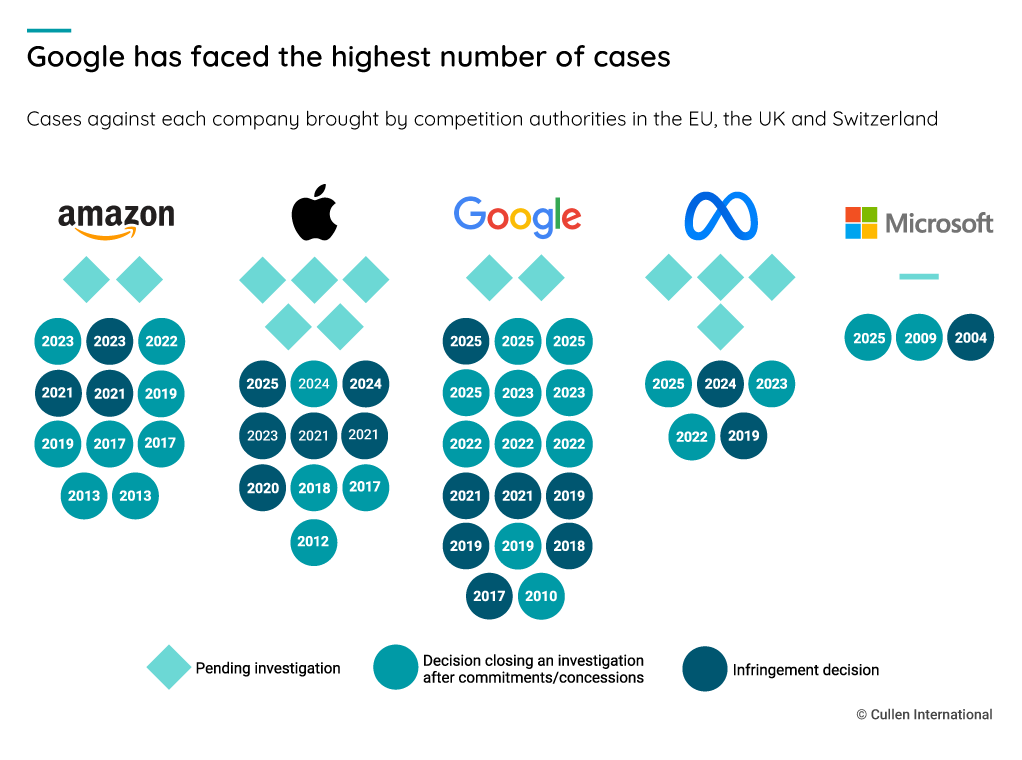
To access the full report, please click on “Access the full content” – or on “Request Access”, in case you are not subscribed to our Antitrust & Mergers service.
more news
04 November 26
In nine European countries, national symmetric obligations on access to ducts go beyond the scope set by the Gigabit Infrastructure Act
Cullen International's latest benchmark analyses asymmetric and symmetric duct access obligations in Europe.
04 November 26
More than 60 cases and counting: a snapshot of European antitrust enforcement against big tech
Cullen International’s latest report on past and pending antitrust cases against big tech companies in Europe tracks enforcement activity under ex post antitrust rules at EU and national level.
30 October 26
Many governments around the globe rely on legal mechanisms to compel communications apps to cooperate in law enforcement investigations
Cullen International's latest Global Trends benchmark for number-independent communications apps regulation found that nearly all of the 13 surveyed jurisdictions around the world provide some legal mechanism to make these apps assist law enforcement in criminal investigations. There are requirements to verify user identities, compel disclosure of stored content, make encrypted content accessible, and duties to detect illegal content within private communications.