The Paris Agreement requires every signatory country to update its goals to fight climate change every five years in the so-called nationally determined contributions (NDCs) reports. The EU, as a party to the Paris Agreement, has set the emissions reduction target of 55% (below 1990 levels) by 2030. Under the Effort Sharing Regulation, individual member states have different emissions reduction targets.
The deadline for the updated NDCs was February 2025 but was postponed to September 2025, due to the lack of NDCs submitted on time.
Cullen International’s updated benchmark shows the emission reduction targets for 2030 and 2035 of the ten largest emitters of greenhouse gases (GHGs), plus the EU and the UK, based on their latest available NDCs. The benchmark also shows by which year the country aims to reach carbon neutrality, if such a target has been set.
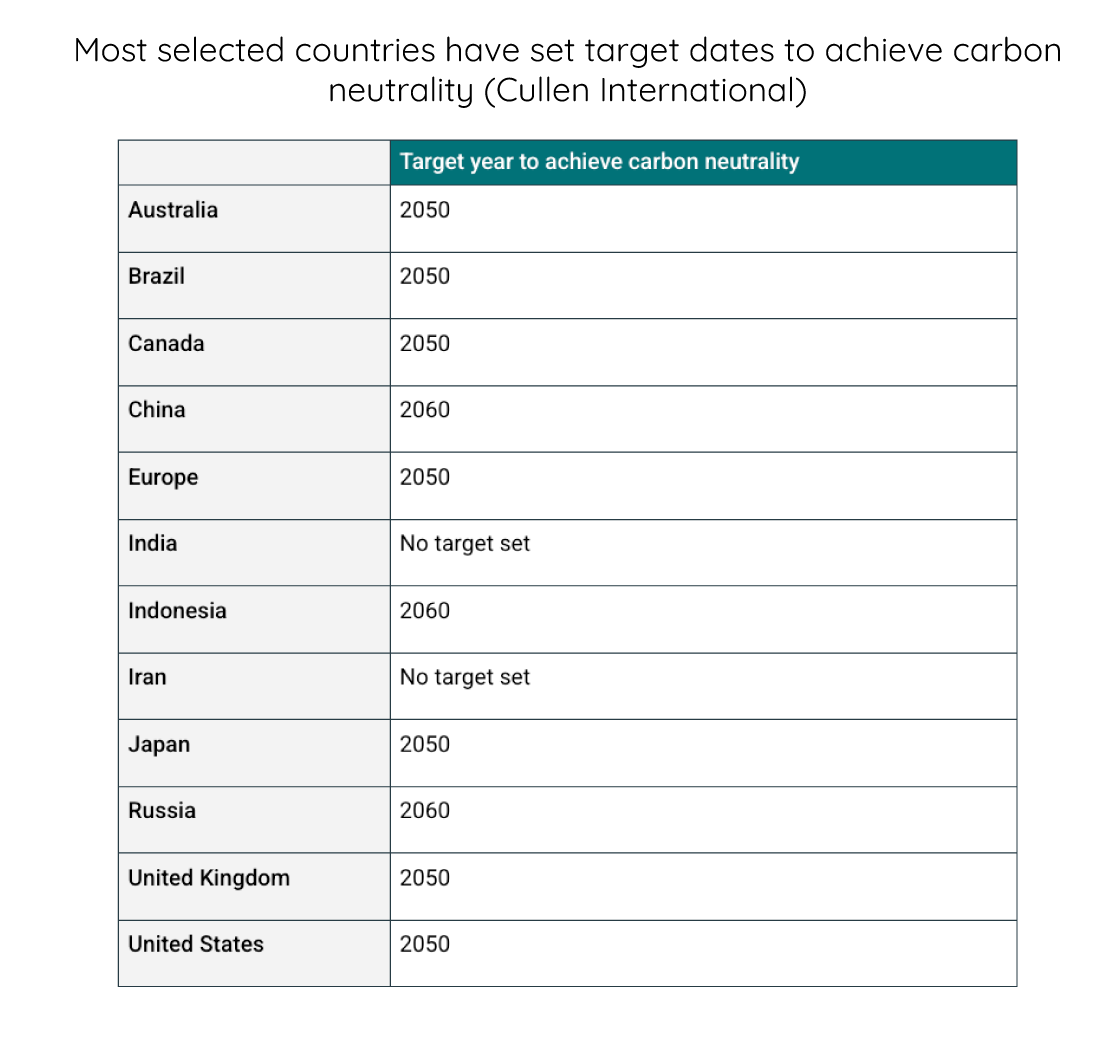
The benchmark also includes:
- information on targets and past and current emission levels;
- the calculation of the annual percentage reduction that would be required each year in order to reach the emission reduction targets; and
- targets that countries have regarding the source of their energy.
For more information and access to the benchmark, please click on “Access the full content” - or on “Request access”, in case you are not subscribed to our Sustainability service.
more news
04 November 26
In nine European countries, national symmetric obligations on access to ducts go beyond the scope set by the Gigabit Infrastructure Act
Cullen International's latest benchmark analyses asymmetric and symmetric duct access obligations in Europe.
04 November 26
More than 60 cases and counting: a snapshot of European antitrust enforcement against big tech
Cullen International’s latest report on past and pending antitrust cases against big tech companies in Europe tracks enforcement activity under ex post antitrust rules at EU and national level.
30 October 26
Many governments around the globe rely on legal mechanisms to compel communications apps to cooperate in law enforcement investigations
Cullen International's latest Global Trends benchmark for number-independent communications apps regulation found that nearly all of the 13 surveyed jurisdictions around the world provide some legal mechanism to make these apps assist law enforcement in criminal investigations. There are requirements to verify user identities, compel disclosure of stored content, make encrypted content accessible, and duties to detect illegal content within private communications.