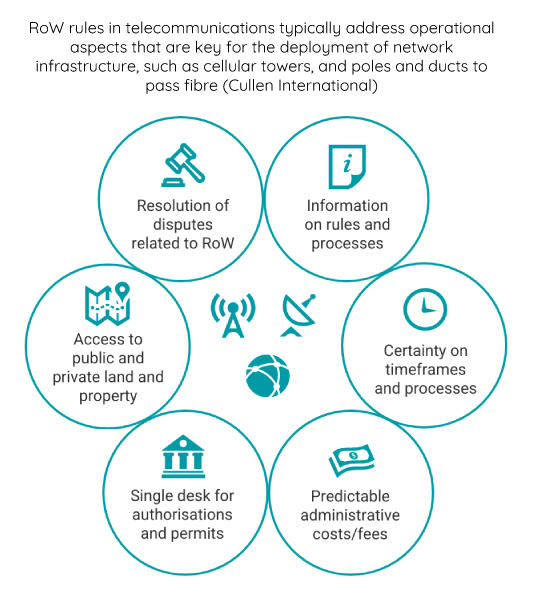
Right of Way (RoW) is the legal permission for telecoms providers to install or maintain infrastructure on public or private land. Importantly, the need to enable telecoms infrastructure roll-out must be balanced with the protection of public assets—such as roads and sewers—as well as environmental considerations and the rights of private property owners.
Telecoms infrastructure providers face several challenges in deploying and operating telecoms networks, including regulatory fragmentation related to RoW, slow approval processes by local authorities, and high and arbitrary charges, amongst other factors.
Therefore, efforts to modernise RoW frameworks are gaining momentum in several jurisdictions around the world, driven by the need to support 5G and fibre deployment and expand digital infrastructure. This Global Trends report explores how various jurisdictions have recently been reforming their RoW frameworks to support their respective 5G and optical fibre network deployments.
The case of India illustrates the challenges central and local governments faced in modernizing RoW regulations, while entirely replacing an outdated and complex telecoms legal framework. Other jurisdictions across various regions—including Brazil, Colombia, the EU, Nigeria, the Philippines, and South Africa—have been updating their RoW frameworks tailored to their specific objectives.
While objectives tend to converge in these policies and regulations (typically, to accelerate and stimulate network coverage in underserved, “high cost” areas for telecoms investment), approaches and related measures vary across jurisdictions. However, industry comments and reactions on the respective measures often highlight challenges still needing to be addressed.
This global trend report addresses in particular:
- RoW rules in the telecoms sector and their operational aspects;
- Challenges related to RoW regulations;
- Measures to modernise RoW frameworks across several jurisdictions.
For more information and to access the full report, please click on “Access the full content” - or on “Request Access”, in case you are not subscribed to the Global Trends service.
more news
04 November 26
In nine European countries, national symmetric obligations on access to ducts go beyond the scope set by the Gigabit Infrastructure Act
Cullen International's latest benchmark analyses asymmetric and symmetric duct access obligations in Europe.
04 November 26
More than 60 cases and counting: a snapshot of European antitrust enforcement against big tech
Cullen International’s latest report on past and pending antitrust cases against big tech companies in Europe tracks enforcement activity under ex post antitrust rules at EU and national level.
30 October 26
Many governments around the globe rely on legal mechanisms to compel communications apps to cooperate in law enforcement investigations
Cullen International's latest Global Trends benchmark for number-independent communications apps regulation found that nearly all of the 13 surveyed jurisdictions around the world provide some legal mechanism to make these apps assist law enforcement in criminal investigations. There are requirements to verify user identities, compel disclosure of stored content, make encrypted content accessible, and duties to detect illegal content within private communications.