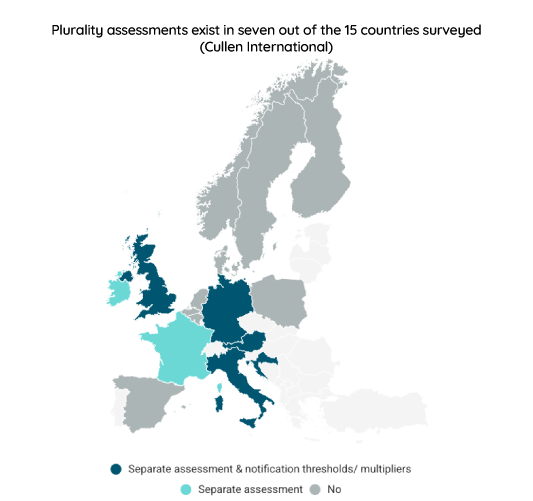
Cullen International published a new benchmark showing in the selected countries whether a separate media plurality assessment of media concentrations exists in national legislation.
Because of the economic and cultural roles of the media, concentrations (mergers) in the media sector do not only have an impact on competition, they can also affect the diversity and pluralism of opinions and views. For these reasons, some member states have established media plurality tests.
The benchmark also shows if there is any information/ plan on the implementation of article 22 of the European Media Freedom Act (EMFA) which requires member states to set up such a media plurality test.
Different plurality assessment models exist
The benchmark shows that the approach taken to assess pluralism in media market concentrations varies widely among the countries surveyed.
In particular, it reveals that separate media plurality assessments exist in seven out of the fifteen countries surveyed.
Implementation of EMFA
Although the EMFA does not require implementing national legislation per se (as it is a regulation), most legislative frameworks will probably require amendments.
For more information on the benchmark, please click on “Access the full content” - or on “Request Access”, in case you are not subscribed to our European Media service.
more news
20 October 26
What European spectrum regulators do when licences are about to expire
Cullen International’s latest European Benchmark shows that 10 of the 21 studied countries have a general policy of organising a new auction whenever spectrum licences expire.
19 October 26
[INFOGRAPHIC] Cullen cheat sheet on the European Commission’s proposal for an EU Kids Act
New Cullen International cheat sheet on the EU Kids Act proposal.
15 October 26
Europe: national rules continue to shape cross-border IoT connectivity
Europe is often treated as a single market for IoT connectivity but, in practice, national rules on SIM registration, numbering and authorisation still differ between countries. Cullen International's latest benchmarks examine these rules across 31 European markets.