Governments in the Americas continue with their plans to award spectrum for the development of 5G networks.
Awards ongoing in 2025 include:
- Brazil and Paraguay expecting to award spectrum in the 3.5 GHz and 700 MHz bands.
- Jamaica published rules for a spectrum award in the 600 MHz band.
The multi-band auction in Costa Rica finished in January 2025. SUTEL awarded national licences in the 700 MHz, 2.3 GHz, 3.5 GHz and 26 GHz bands to Claro and Liberty, as well as local licences to five operators.
In January 2025, Venezuela awarded 50 MHz in the 3.5 GHz band to Digitel and 40 MHz in the 2.6 GHz band to Movistar.
Mexico announced the cancellation of its IFT-12 spectrum award on 16 January 2025.
Brazilian plans for future work on spectrum regulation includes spectrum cap regulation and satellite services. Colombia also updated its spectrum master plan and will focus on making more spectrum available for different services.
Canada, the Dominican Republic, Honduras, Panama and the USA made several changes to mobile service allocation and to satellite spectrum use rules in line with decisions made at WRC-23.
Examples of our data visualization:
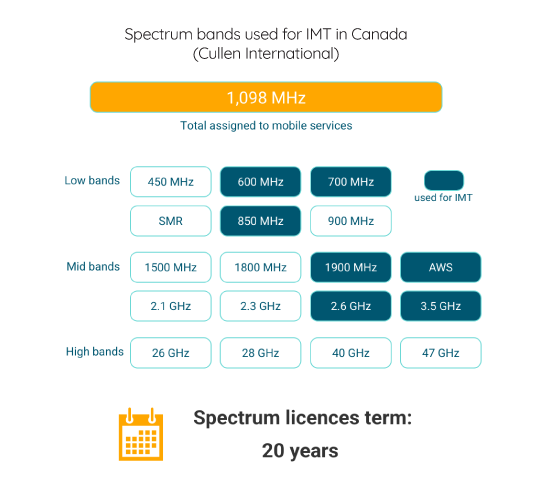

For more information and access to our latest 'Americas Spectrum Profiles' report, please click on “Access the full content” - or on “Request Access”, in case you are not subscribed to our Americas Spectrum service.
more news
04 November 26
In nine European countries, national symmetric obligations on access to ducts go beyond the scope set by the Gigabit Infrastructure Act
Cullen International's latest benchmark analyses asymmetric and symmetric duct access obligations in Europe.
04 November 26
More than 60 cases and counting: a snapshot of European antitrust enforcement against big tech
Cullen International’s latest report on past and pending antitrust cases against big tech companies in Europe tracks enforcement activity under ex post antitrust rules at EU and national level.
30 October 26
Many governments around the globe rely on legal mechanisms to compel communications apps to cooperate in law enforcement investigations
Cullen International's latest Global Trends benchmark for number-independent communications apps regulation found that nearly all of the 13 surveyed jurisdictions around the world provide some legal mechanism to make these apps assist law enforcement in criminal investigations. There are requirements to verify user identities, compel disclosure of stored content, make encrypted content accessible, and duties to detect illegal content within private communications.