Our latest research provides a summary of key developments since June 2024 on national 5G security initiatives in the 27 EU member states, Norway, Switzerland, and the UK.
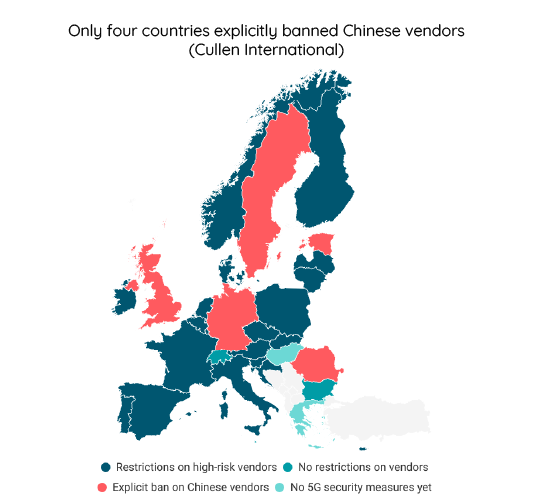
Germany and Estonia were added to the list of countries that banned Huawei and/or ZTE. Based on publicly available information, these countries, together with Romania and Sweden, are the only EU countries that explicitly banned Chinese 5G equipment vendors.
Estonia
Elisa contested the decision of Estonian administrative authorities that labelled Huawei as an HRV before the administrative court of Tallinn. The court requested a preliminary ruling from the Court of Justice of the EU (CJEU).
The CJEU will address several questions, for example whether:
- the Estonian legislation restricting HRVs is compatible with EU law, including the principle of proportionality; and
- the requirement to remove already deployed hardware and software could be considered as expropriation of property.
Germany
The German government announced in July 2024 that mobile network operators (MNOs) should stop using 5G critical components from Huawei and ZTE by the end of 2026 in the core network.
In the RAN, MNOs can still use antennas from the above vendors, but they will replace network management systems (NMS) with solutions from other vendors by the end of 2029.
The restrictions would be laid down in contracts concluded between the government and MNOs.
For more information and access to our full benchmark on 5G security measures across Europe, please click on “Access the full content” - or on “Request Access”, in case you are not subscribed to our European Digital Economy service.
>> See also our benchmark on 5G security measures across the Americas!
more news
12 October 26
Seven of 13 European countries require opt-in for commercial calls
Cullen International's latest benchmark compares the rules on unsolicited commercial communications in 13 European countries.
09 October 26
Four LATAM countries address connectivity gaps
Cullen International’s latest LATAM Telecoms Update highlights policy developments over the past three months affecting the regulation of radio spectrum, wholesale networks and consumer protection in six markets in the region: Argentina, Brazil, Chile, Colombia, Mexico and Peru.
08 October 26
Many European countries consider banning minors from accessing social media
Cullen International has just published a new version of its benchmark which tracks the current debates/ initiatives on banning access to social media to protect minors online in Europe.