Fibre co-investment projects in most European countries have attracted investors from outside the telecoms sector, such as private equity funds or utilities. Only in three countries have such projects only included telecoms operators. This is just one of the key findings from Cullen International’s latest research.
The European Electronic Communications Code aims to stimulate the deployment or upgrade of new fibre networks, including through co-investment. Cullen International’s benchmark analyses the main co-investment initiatives for the rollout of fibre networks in 14 European countries, specifying the type of co-investment model adopted: joint-venture, reciprocal access or one-way access.
Among the main findings of the benchmark are that:
- Half of the countries adopted a joint-venture model, three (France, Italy, Switzerland) adopted a one-way access model, two (Czech Republic and Portugal) chose reciprocal access, and in Germany and Spain multiple models were chosen across different projects.
- Certain co-investment projects are open to additional potential co-investors, including in France (which mandates open co-investments in less densely populated areas), Belgium, Germany, Ireland and Switzerland. In Italy, potential co-investors have until 2030 to join the co-investment project.
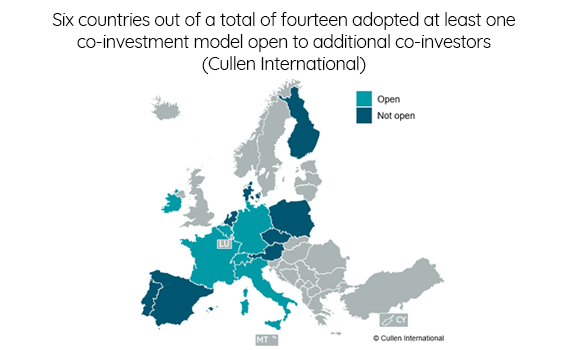
For more information or to access the benchmark, please click on “Access the full content” - or on “Request Access”, in case you are not subscribed to our European Telecoms Service.
more news
04 November 26
In nine European countries, national symmetric obligations on access to ducts go beyond the scope set by the Gigabit Infrastructure Act
Cullen International's latest benchmark analyses asymmetric and symmetric duct access obligations in Europe.
04 November 26
More than 60 cases and counting: a snapshot of European antitrust enforcement against big tech
Cullen International’s latest report on past and pending antitrust cases against big tech companies in Europe tracks enforcement activity under ex post antitrust rules at EU and national level.
30 October 26
Many governments around the globe rely on legal mechanisms to compel communications apps to cooperate in law enforcement investigations
Cullen International's latest Global Trends benchmark for number-independent communications apps regulation found that nearly all of the 13 surveyed jurisdictions around the world provide some legal mechanism to make these apps assist law enforcement in criminal investigations. There are requirements to verify user identities, compel disclosure of stored content, make encrypted content accessible, and duties to detect illegal content within private communications.