In the Americas there is an awareness of the need to enhance consumer protection while simplifying the contracting process.
Telecommunications service contracts, including fixed and mobile broadband and telephone services, must comply with regulated terms and conditions. These may include:
- use of plain language;
- clear statement of key contract terms and conditions; and
- technical characteristics of the service.
Cullen International’s latest research shows that, among 11 surveyed countries only Colombia and Peru established a standard contract model for telecoms services that was defined directly by the regulatory authority. Another eight surveyed countries establish specific requirements for adhesion contracts (contracts which offer new customers a special price or other advantages for an introductory period). Argentina, Costa Rica, Ecuador, Mexico and Paraguay also require specific approval by the regulator of the contract model prepared by each individual operator.
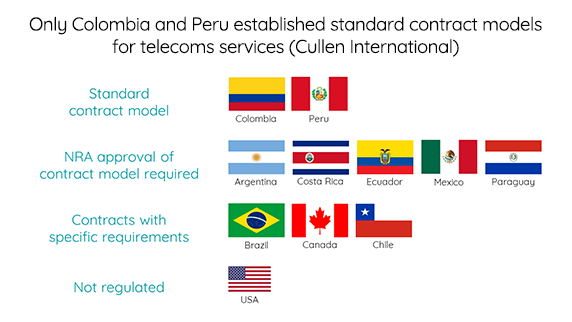
Most of the surveyed countries apply the same rules for fixed and mobile broadband and telephone services. Canada and Paraguay established specific requirements for fixed broadband services. The United States is the only country without regulation on the matter.
Cullen International’s new Americas Telecoms benchmark shows the regulation on standard contract models, the specific requirements for adhesion contracts, and the regulation of minimum contract terms.
To access the full benchmark, please click on “Access the full content” - or on “Request Access”, in case you are not subscribed to our Americas Telecoms Service.
more news
04 November 26
In nine European countries, national symmetric obligations on access to ducts go beyond the scope set by the Gigabit Infrastructure Act
Cullen International's latest benchmark analyses asymmetric and symmetric duct access obligations in Europe.
04 November 26
More than 60 cases and counting: a snapshot of European antitrust enforcement against big tech
Cullen International’s latest report on past and pending antitrust cases against big tech companies in Europe tracks enforcement activity under ex post antitrust rules at EU and national level.
30 October 26
Many governments around the globe rely on legal mechanisms to compel communications apps to cooperate in law enforcement investigations
Cullen International's latest Global Trends benchmark for number-independent communications apps regulation found that nearly all of the 13 surveyed jurisdictions around the world provide some legal mechanism to make these apps assist law enforcement in criminal investigations. There are requirements to verify user identities, compel disclosure of stored content, make encrypted content accessible, and duties to detect illegal content within private communications.