Cullen International’s new Global Trends report covers the evolution of 5G services in 13 major economies across the globe: Australia, Brazil, China, the European Union (EU), Hong Kong, India, Japan, Korea, Malaysia, New Zealand, Singapore, South Africa and the United States (US). The research addresses:
- the status of 5G network deployment and commercial offers;
- government strategies and actions that promote the deployment of 5G networks; and
- how governments have assigned spectrum for 5G services.
Except for India and Malaysia, 5G services are commercially available in some geographic areas in all of the other surveyed economies.
In the 11 economies where 5G services are commercially available, the research shows:
- 5G services are offered at no extra cost to 4G services in four economies.
- Specific 5G tariffs are applied in seven economies. The price of the lowest 5G retail tariff available fell in four of those economies surveyed and was unchanged in three compared to the previous update of the benchmark in April 2021.
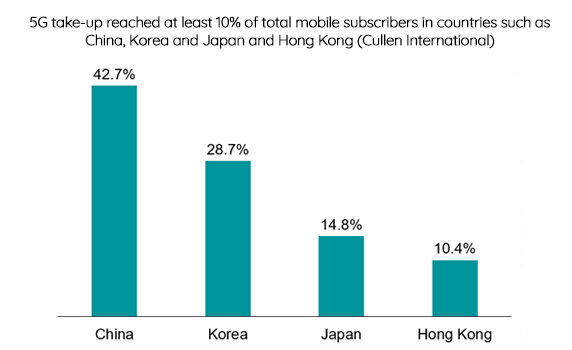
Governments continue promoting the adoption of 5G, although the specific amount of public money invested in 5G-related initiatives varies widely. In Australia, the AUD 40m (US$29.3m) 5G innovation initiative funds case studies and trials, while in the EU two funding programmes will invest €9.5bn (US$10.5bn) until 2027 in projects that could be relevant for 5G.
5G spectrum assignments in countries surveyed continued to take place over the course of 2021 and start of 2022. For example the US awarded 280 MHz of spectrum in the 3.7 GHz band for US$81.1bn in February 2021, a new auction record. In Brazil, winning bidders committed to spending US$9.03bn in one-off spectrum fees, fulfilling coverage targets and other obligations to acquire spectrum in the 700 MHz, 2.3 GHz, 3.5 GHz and 26 GHz bands in November 2021.
For more information on the full 5G research, please click on “Access the full content” or on “Request Access”, in case you are not subscribed to our Global Trends service.
more news
15 October 26
Europe: national rules continue to shape cross-border IoT connectivity
Europe is often treated as a single market for IoT connectivity but, in practice, national rules on SIM registration, numbering and authorisation still differ between countries. Cullen International's latest benchmarks examine these rules across 31 European markets.
14 October 26
Regulators worldwide take several distinct approaches to legally defining communications apps, authorise their operation and govern their interoperability
Cullen International's latest Global Trends benchmark for communications apps regulation found diverse regulatory approaches to the legal definition, licensing and interoperability of number-independent communications apps. The benchmark addresses regulation of apps such as WhatsApp, WeChat and iMessage across 13 jurisdictions around the world.
13 October 26
Almost half of surveyed countries in the Americas have commercial D2D satellite services
Cullen International’s latest Benchmark compares the regulatory conditions for D2D satellite services using terrestrial IMT spectrum across 12 countries in the Americas.