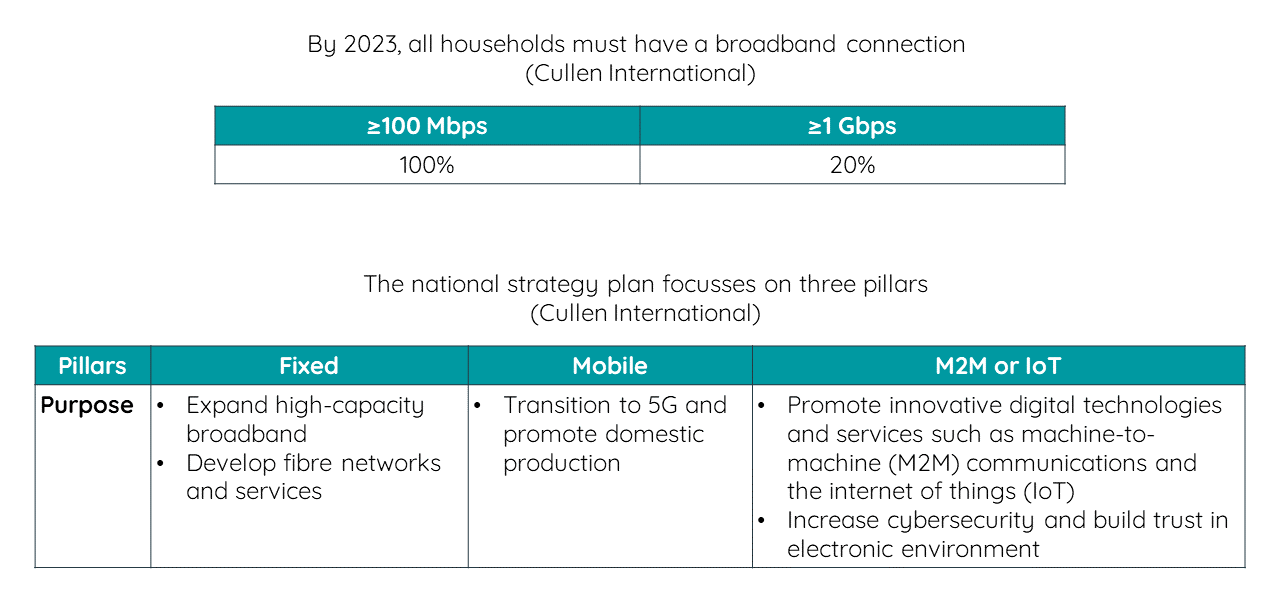
Cullen International’s new Country Profile includes details of Turkey’s ambitious broadband plans which include 100% household coverage of 100 Mbps broadband connectivity by 2023. The national strategy plan also includes the transition to 5G services, and the promotion of innovative digital technologies, such as M2M and IoT applications.
Turkey’s main policy goals for the telecoms sector are set out in the telecommunications regulator BTK’s national strategy plan for 2019–2023 and in the national broadband strategy and action plan for 2017–2020 (Plan).
In December 2017, the Plan highlighted that OTT services are expected to increase with the development of high-speed broadband infrastructures and therefore proposed actions to support domestic OTT providers.
The new Turkey Country Profile provides information on the:
- regulatory and policy outlook;
- competition framework;
- consumer protection; and
- an overview of market data.
Cullen International's complete set of MENA Telecoms Profiles provides in-depth coverage of the telecoms policies, regulatory frameworks and market data in 14 Middle East and North African countries.
To access the full report, please click on “Access the full content” - or on “Request Access”, in case you are not subscribed to our MENA Telecoms Service.
more news
22 October 26
IoT regulation: new operational requirements reshape global connectivity
Cullen International's Quarterly Regulatory Update on IoT and M2M Services (Q3 2026) highlights how national regulators around the globe are shaping the future of IoT and M2M services.
21 October 26
Americas countries require satellite service providers to obtain a spectrum licence
Cullen International’s latest benchmark compares satellite regulation across the Americas, including service and spectrum licensing, registration requirements, spectrum allocations and fees, interference rules, migration between frequency bands and recent regulatory developments.
21 October 26
Around the world, many regulators examined communications apps through distinct lenses, but their interventions did not always lead to any enforcement
Cullen International's latest Global Trends benchmark for communications apps regulation shows how telecoms, consumer protection, data protection and competition regulators intervene in the number-independent communications apps sector. The benchmark addresses regulation apps such as WhatsApp, WeChat and iMessage across 13 jurisdictions around the world.