Policymakers around the world have started looking at possible approaches to address the competitive challenges posed by the market power of big tech companies across different sectors of the digital economy in their respective countries.
According to new global research by Cullen International, there are different approaches to face these challenges, depending on the respective countries’ aggressiveness in scrutinising the market power of online platforms and the potential issues that each country wants to prioritise in their policies.
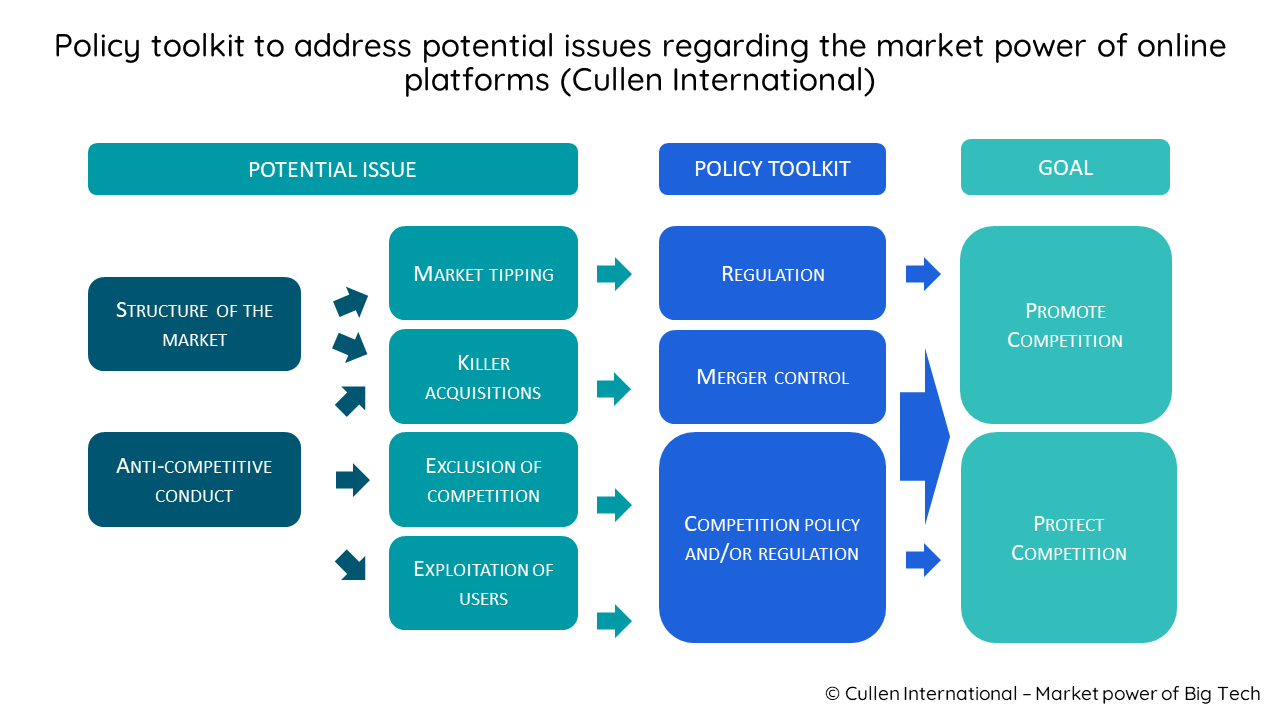
Among the countries covered by the new Global Trends research, Brazil, Mexico, Singapore and Turkey conducted studies but for the time being maintain a “wait and see” approach over new rules. China and the US on the other hand, have been pursuing reforms in their existing competition frameworks.
Other countries covered in the new Cullen International research adopted or have proposed to adopt a “competition policy crossed with regulation” approach. Under this approach, ex post measures are combined with ex ante measures addressed to certain online platforms. With different levels of aggressiveness, this is the case of Australia, the European Union, India, Japan, South Africa, and South Korea.
Read the full research on market power of Big Tech and discover how big tech platforms are regulated across 12 different geographies around the world by clicking on “Access the full content” (Global Trends clients).
To request the report or a demo of the Global Trends service, click on “Request Access”, in case you are not subscribed to our Global Trends service.
more news
04 November 26
In nine European countries, national symmetric obligations on access to ducts go beyond the scope set by the Gigabit Infrastructure Act
Cullen International's latest benchmark analyses asymmetric and symmetric duct access obligations in Europe.
04 November 26
More than 60 cases and counting: a snapshot of European antitrust enforcement against big tech
Cullen International’s latest report on past and pending antitrust cases against big tech companies in Europe tracks enforcement activity under ex post antitrust rules at EU and national level.
30 October 26
Many governments around the globe rely on legal mechanisms to compel communications apps to cooperate in law enforcement investigations
Cullen International's latest Global Trends benchmark for number-independent communications apps regulation found that nearly all of the 13 surveyed jurisdictions around the world provide some legal mechanism to make these apps assist law enforcement in criminal investigations. There are requirements to verify user identities, compel disclosure of stored content, make encrypted content accessible, and duties to detect illegal content within private communications.