Cullen International’s new Tracker makes a comparison between the European Commission’s 2 GHz band MSS proposals and the existing framework.
It includes a detailed analysis of the proposed selection procedures, eligibility and ranking criteria, spectrum allocation, fees, licence duration, transfer and leasing rules, transitional arrangements and the legislative process.
Adjusting to new circumstances
The proposed regulation of May 2026 would replace the current framework with a centralised EU process for selecting, authorising and overseeing operators in the band. It would also substantially reshape how the 2 GHz MSS band is allocated, reserving the majority of the spectrum for EU-owned or controlled operators. The existing spectrum rights held by Inmarsat (acquired by Viasat in 2023) and Solaris (acquired by EchoStar in 2014) are due to expire in May 2027.
The proposal reflects growing demand for satellite connectivity, internet-of-things (IoT) and direct-to-device (D2D) services, as well as increased EU focus on security, resilience, technological sovereignty and strategic autonomy. It is also closely linked to the EU-level satellite authorisation framework proposed under the Digital Networks Act (DNA).
Three parallel selection procedures
The draft regulation’s key feature is the introduction of three parallel selection procedures:
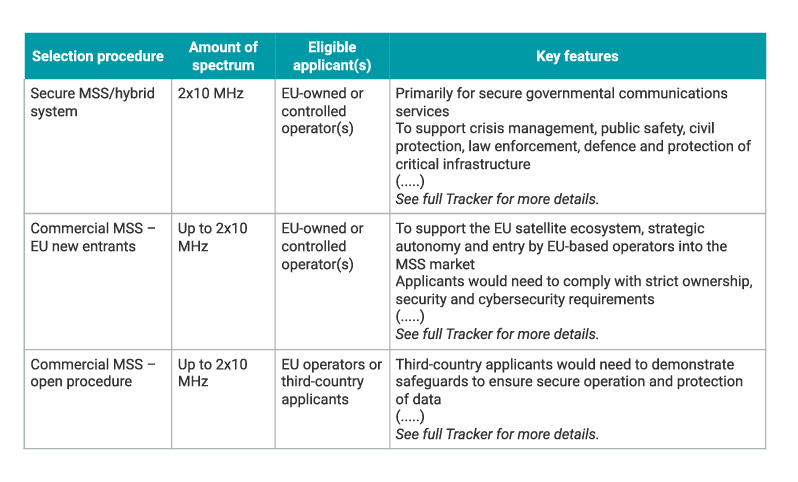
For more details and for access to the full Tracker, please click on “Access the full content” - or on “Request Access”, in case you are not subscribed to our European Telecoms service.
See also our 2 GHz benchmark for the Americas.
more news
04 November 26
In nine European countries, national symmetric obligations on access to ducts go beyond the scope set by the Gigabit Infrastructure Act
Cullen International's latest benchmark analyses asymmetric and symmetric duct access obligations in Europe.
04 November 26
More than 60 cases and counting: a snapshot of European antitrust enforcement against big tech
Cullen International’s latest report on past and pending antitrust cases against big tech companies in Europe tracks enforcement activity under ex post antitrust rules at EU and national level.
30 October 26
Many governments around the globe rely on legal mechanisms to compel communications apps to cooperate in law enforcement investigations
Cullen International's latest Global Trends benchmark for number-independent communications apps regulation found that nearly all of the 13 surveyed jurisdictions around the world provide some legal mechanism to make these apps assist law enforcement in criminal investigations. There are requirements to verify user identities, compel disclosure of stored content, make encrypted content accessible, and duties to detect illegal content within private communications.