Cullen International's Legislation Navigator displays the official text of the European Commission's proposed Digital Networks Act (DNA).
Now this tool also offers a direct view of the recitals related to each article. It allows easier browsing through the 416 recitals and 210 articles.
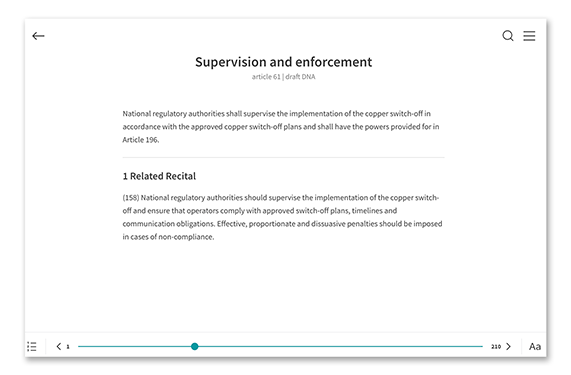
For background, recitals are not binding provisions. Recitals can explain the legislator's reasoning and the objectives behind the rules set out in the articles.
The Legislation Navigator also includes a "Compare" feature that makes comparisons of the proposed DNA with the European Electronic Communications Code (EECC) that is currently in force.

The Cullen Legislation Navigator is an online tool to locate and review the most important EU legislative provisions in the Telecoms, Digital Economy, Audiovisual Media, Postal sector, Sustainability and Competition Law.
To discover the DNA module in the Legislation Navigator, please click on “Access the full content” if you are a client of our European Telecoms service - or on “Request Access” for a free demo of the Legislation Navigator and extended DNA coverage.
more news
04 November 26
In nine European countries, national symmetric obligations on access to ducts go beyond the scope set by the Gigabit Infrastructure Act
Cullen International's latest benchmark analyses asymmetric and symmetric duct access obligations in Europe.
04 November 26
More than 60 cases and counting: a snapshot of European antitrust enforcement against big tech
Cullen International’s latest report on past and pending antitrust cases against big tech companies in Europe tracks enforcement activity under ex post antitrust rules at EU and national level.
30 October 26
Many governments around the globe rely on legal mechanisms to compel communications apps to cooperate in law enforcement investigations
Cullen International's latest Global Trends benchmark for number-independent communications apps regulation found that nearly all of the 13 surveyed jurisdictions around the world provide some legal mechanism to make these apps assist law enforcement in criminal investigations. There are requirements to verify user identities, compel disclosure of stored content, make encrypted content accessible, and duties to detect illegal content within private communications.