Artificial intelligence (AI) policy in the Caribbean varies and remains at an early stage. Some countries are developing strategies, institutions and readiness assessments, while others have no specific AI policy.
Key takeaways
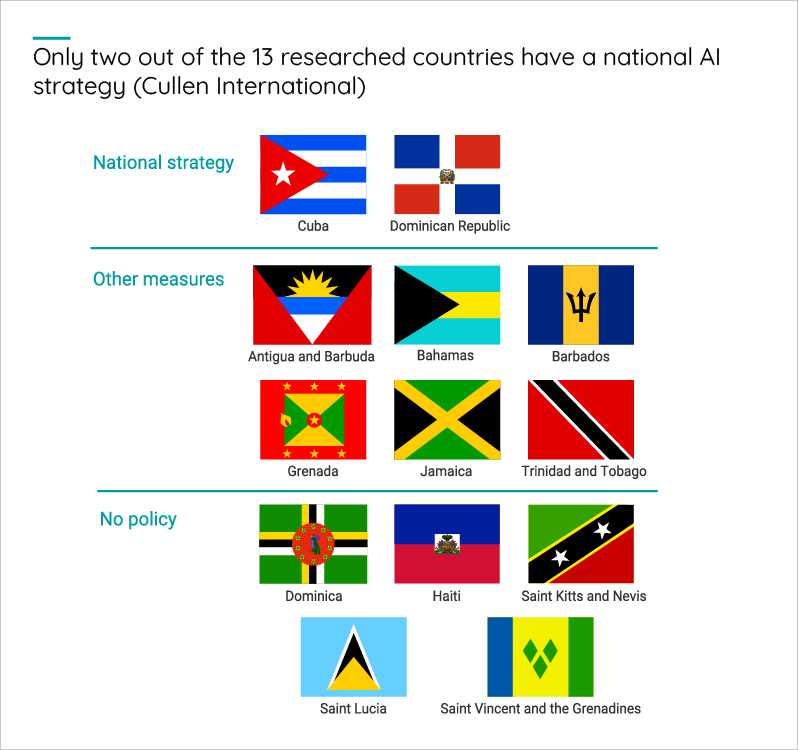
- Only Cuba and the Dominican Republic have adopted national AI strategies
- Many countries appointed organisations or officers to coordinate AI efforts
- Readiness assessments show countries in the region should adopt AI-specific regulatory frameworks and create implementation mechanisms for AI policy goals
Why it matters
National AI strategies can help countries implement policy goals to maximise the benefits AI can offer citizens and to promote economic growth. In addition, UNESCO recommends enacting AI-specific regulatory frameworks to ensure ethical principles are promoted in AI development and adoption.
Background
Caribbean countries are gradually incorporating AI into their digital transformation and development policies. However, none of the 13 countries covered has adopted an AI-specific regulatory framework. National approaches are currently based mainly on non-binding strategies and readiness assessments. UNESCO’s 2021 Recommendation on the Ethics of AI provides an international policy framework for developing ethical and responsible AI governance.
Cullen International’s new benchmark covers AI policy and regulation across 13 countries in the Caribbean, including AI strategies and readiness.
Scope
Region: Americas
Countries covered: Antigua and Barbuda, Bahamas, Barbados, Cuba, Dominica, Dominican Republic, Grenada, Haiti, Jamaica, Saint Kitts and Nevis, Saint Lucia, Saint Vincent and the Grenadines, Trinidad and Tobago
Policy area: Artificial intelligence
Last updated: September 2026
To access the full benchmark, please click on “Access the full content” - or on “Request Access”, in case you are not subscribed to our Americas Digital Economy service.
more news
19 October 26
[INFOGRAPHIC] Cullen cheat sheet on the European Commission’s proposal for an EU Kids Act
New Cullen International cheat sheet on the EU Kids Act proposal.
15 October 26
Europe: national rules continue to shape cross-border IoT connectivity
Europe is often treated as a single market for IoT connectivity but, in practice, national rules on SIM registration, numbering and authorisation still differ between countries. Cullen International's latest benchmarks examine these rules across 31 European markets.
14 October 26
Regulators worldwide take several distinct approaches to legally defining communications apps, authorise their operation and govern their interoperability
Cullen International's latest Global Trends benchmark for communications apps regulation found diverse regulatory approaches to the legal definition, licensing and interoperability of number-independent communications apps. The benchmark addresses regulation of apps such as WhatsApp, WeChat and iMessage across 13 jurisdictions around the world.