The upper 6 GHz band "will be the primary band suitable for the introduction of 6G in Europe by 2030", according to a recent draft opinion of the EU Radio Spectrum Policy Group.
Cullen International has been monitoring regulation of the upper 6 GHz band at the European level and now also benchmarks regulation at the national level in Europe.
Key takeaways
- Most EU member states have not yet published plans and are waiting for EU-level decisions, which are expected for 2027.
- Some regulators, such as ARCEP (France) and BNetzA (Germany), have started to include the band in consultations on possible future awards.
- The UK regulator Ofcom recently presented its own proposal for the future of the 6 GHz band.
The upper 6 GHz band is currently subject to competing industry demands. Wi-Fi and 5G are both standardised for the entire 6 GHz band (5925–7125 MHz). Europe uses the lower band (5945–6425 MHz) for Wi-Fi since 2021 and is exploring different options of spectrum sharing for the upper band (6425–7125 MHz).
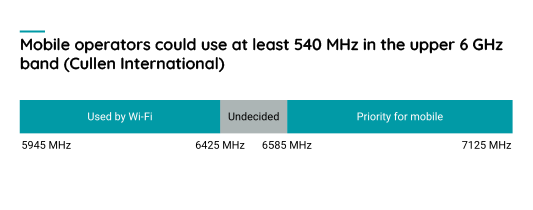
The Radio Spectrum Policy Group recommended in November 2025 to prioritise the majority of the upper band (6585–7125 MHz) for mobile technologies like 5G and 6G.
For more information and access to the full benchmark, please click on “Access the full content” - or on “Request Access”, in case you are not subscribed to our European Radio Spectrum service.
Scope
Region: Europe
Countries covered: 19 EU member states, plus Switzerland and the UK
Policy area: radio spectrum
Last updated: February 2026
more news
22 October 26
IoT regulation: new operational requirements reshape global connectivity
Cullen International's Quarterly Regulatory Update on IoT and M2M Services (Q3 2026) highlights how national regulators around the globe are shaping the future of IoT and M2M services.
21 October 26
Americas countries require satellite service providers to obtain a spectrum licence
Cullen International’s latest benchmark compares satellite regulation across the Americas, including service and spectrum licensing, registration requirements, spectrum allocations and fees, interference rules, migration between frequency bands and recent regulatory developments.
21 October 26
Around the world, many regulators examined communications apps through distinct lenses, but their interventions did not always lead to any enforcement
Cullen International's latest Global Trends benchmark for communications apps regulation shows how telecoms, consumer protection, data protection and competition regulators intervene in the number-independent communications apps sector. The benchmark addresses regulation apps such as WhatsApp, WeChat and iMessage across 13 jurisdictions around the world.