A new Global Trends report assesses gigabit network progress across 15 jurisdictions worldwide, examining critical deployment factors and strategic approaches. The report covers Australia, Brazil, Canada, China, the EU, India, Japan, Korea, Malaysia, New Zealand, Singapore, South Africa, Türkiye, the UK and the US.
The report covers:
- Government targets and gigabit network availability across different markets.
- Financial incentives and direct government intervention strategies.
- Pro-deployment policies and regulatory frameworks.
- Copper decommissioning status and transition strategies.
- Public-private partnership models and their effectiveness.
- Infrastructure sharing policies and deployment acceleration.
- Rural coverage challenges and funding mechanisms.
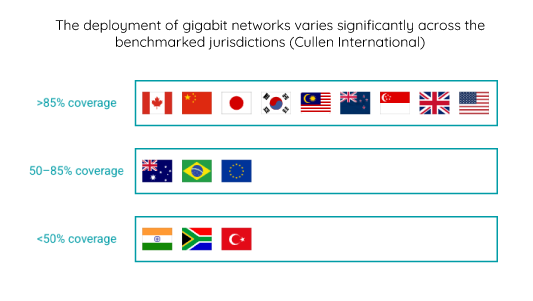
While leading markets like Japan, Korea and Singapore have achieved near-universal gigabit coverage exceeding 90% of premises, other jurisdictions including India and Türkiye remain at around 30-40% coverage, highlighting potential digital divides that could widen competitive gaps between nations.
The report reveals that fibre-to-the-premises (FTTP) has emerged as a technology for future-proof scalability, while jurisdictions with extensive cable infrastructure are also leveraging DOCSIS upgrades as cost-effective solutions. The most successful deployments feature government involvement alongside private investment, with models ranging from Singapore's government-backed wholesale network to hybrid approaches with targeted subsidies.
For more information and to access the full report, please click on "Access the full content" - or on "Request Access", in case you are not subscribed to our Global Trends service.
more news
04 November 26
In nine European countries, national symmetric obligations on access to ducts go beyond the scope set by the Gigabit Infrastructure Act
Cullen International's latest benchmark analyses asymmetric and symmetric duct access obligations in Europe.
04 November 26
More than 60 cases and counting: a snapshot of European antitrust enforcement against big tech
Cullen International’s latest report on past and pending antitrust cases against big tech companies in Europe tracks enforcement activity under ex post antitrust rules at EU and national level.
30 October 26
Many governments around the globe rely on legal mechanisms to compel communications apps to cooperate in law enforcement investigations
Cullen International's latest Global Trends benchmark for number-independent communications apps regulation found that nearly all of the 13 surveyed jurisdictions around the world provide some legal mechanism to make these apps assist law enforcement in criminal investigations. There are requirements to verify user identities, compel disclosure of stored content, make encrypted content accessible, and duties to detect illegal content within private communications.