Our latest research provides a summary of key developments since January 2025 on national 5G security initiatives in the 27 EU member states, Norway, Switzerland, and the UK.
Relevant developments have been observed in Norway, Poland and Sweden.
In Norway, the new Electronic Communications Act entered into force on 1 January 2025. It enables national authorities to refuse the granting of spectrum frequency licences to equipment vendors from countries without a security agreement with Norway. This was also possible within the previous framework, but the legal basis is made more explicit in the new legislation.
In Poland, the latest amendments to the draft Cybersecurity Act were presented on 7 February 2025. The amendments would maintain the proposed obligation for telecoms operators to withdraw equipment from high-risk vendors (HRVs) within four years after their designation.
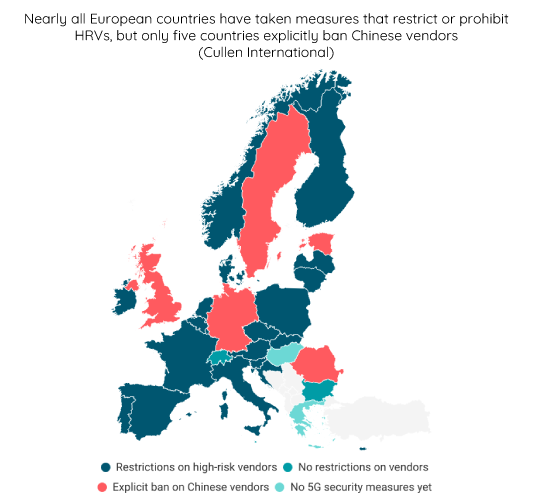
The European Commission filed an application to intervene as a non-disputing party in the arbitration proceeding initiated by Huawei against Sweden before the World Bank Group’s International Centre for Settlement of Investment Disputes (ICSID). The Commission aimed to address the EU rules on the security of 5G networks and member states’ margin of discretion in defining and ensuring their essential security interests. On 26 June 2024, the ICSID allowed this. The final outcome of the case is pending.
For more information and access to our full benchmark on 5G security measures across Europe, please click on “Access the full content” - or on “Request Access”, in case you are not subscribed to our European Digital Economy service.
more news
04 November 26
In nine European countries, national symmetric obligations on access to ducts go beyond the scope set by the Gigabit Infrastructure Act
Cullen International's latest benchmark analyses asymmetric and symmetric duct access obligations in Europe.
04 November 26
More than 60 cases and counting: a snapshot of European antitrust enforcement against big tech
Cullen International’s latest report on past and pending antitrust cases against big tech companies in Europe tracks enforcement activity under ex post antitrust rules at EU and national level.
30 October 26
Many governments around the globe rely on legal mechanisms to compel communications apps to cooperate in law enforcement investigations
Cullen International's latest Global Trends benchmark for number-independent communications apps regulation found that nearly all of the 13 surveyed jurisdictions around the world provide some legal mechanism to make these apps assist law enforcement in criminal investigations. There are requirements to verify user identities, compel disclosure of stored content, make encrypted content accessible, and duties to detect illegal content within private communications.