Especially when compared with other world regions, sub-Saharan Africa tends to be positioned at an initial phase of 5G development. However, according to new Global Trends research, some countries in the region have started acting on 5G.
Cullen International’s new global trends research shows that some governments have already a strategy on 5G, and in some cases have also released (or planned the release of) international mobile telecommunications (IMT) spectrum to enable 5G network deployments. On the other hand, in other countries selected industry players have decided to test the technology, and even started small-scale commercial deployments.
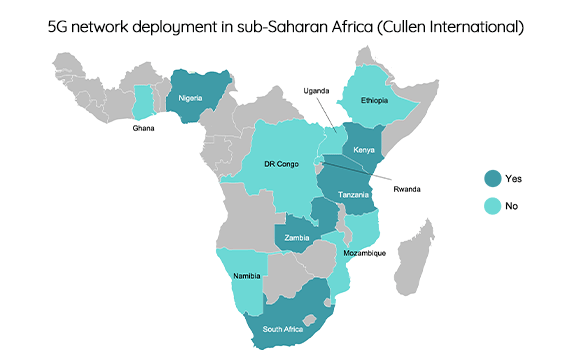
The new benchmark outlines 5G government policies, spectrum plans, and the status of deployments and commercial availability, across 12 countries: Democratic Republic of Congo (DRC), Ethiopia, Ghana, Kenya, Mozambique, Namibia, Nigeria, Rwanda, South Africa, Tanzania, Uganda, and Zambia.
For more information and to access the benchmark, please click on “Access the full content” - or on “Request Access”, in case you are not subscribed to our Global Trends service.
more news
04 November 26
In nine European countries, national symmetric obligations on access to ducts go beyond the scope set by the Gigabit Infrastructure Act
Cullen International's latest benchmark analyses asymmetric and symmetric duct access obligations in Europe.
04 November 26
More than 60 cases and counting: a snapshot of European antitrust enforcement against big tech
Cullen International’s latest report on past and pending antitrust cases against big tech companies in Europe tracks enforcement activity under ex post antitrust rules at EU and national level.
30 October 26
Many governments around the globe rely on legal mechanisms to compel communications apps to cooperate in law enforcement investigations
Cullen International's latest Global Trends benchmark for number-independent communications apps regulation found that nearly all of the 13 surveyed jurisdictions around the world provide some legal mechanism to make these apps assist law enforcement in criminal investigations. There are requirements to verify user identities, compel disclosure of stored content, make encrypted content accessible, and duties to detect illegal content within private communications.