Our new benchmark on internet of things (IoT) regulation in the Middle East and North Africa shows that three countries have adopted specific regulation for IoT.
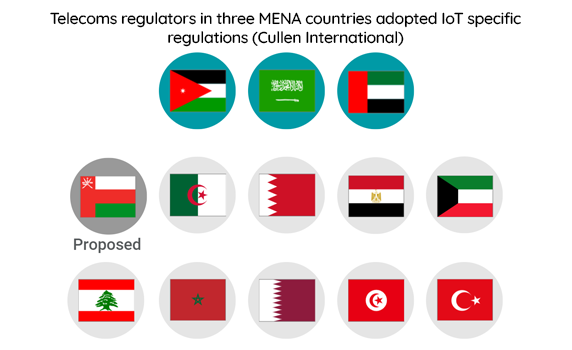
The benchmark sheds light on the licensing requirements for IoT services in 13 MENA countries, as well as the use of spectrum and identifiers such as mobile numbers.
The benchmark further shows that two countries have banned permanent roaming for IoT and require that the SIM card used in IoT devices must be from the country itself.
For more information and access to the full report, please click on “Access the full content” - or on “Request Access”, in case you are not subscribed to our MENA Telecoms service.
more news
15 October 26
Europe: national rules continue to shape cross-border IoT connectivity
Europe is often treated as a single market for IoT connectivity but, in practice, national rules on SIM registration, numbering and authorisation still differ between countries. Cullen International's latest benchmarks examine these rules across 31 European markets.
14 October 26
Regulators worldwide take several distinct approaches to legally defining communications apps, authorise their operation and govern their interoperability
Cullen International's latest Global Trends benchmark for communications apps regulation found diverse regulatory approaches to the legal definition, licensing and interoperability of number-independent communications apps. The benchmark addresses regulation of apps such as WhatsApp, WeChat and iMessage across 13 jurisdictions around the world.
13 October 26
Almost half of surveyed countries in the Americas have commercial D2D satellite services
Cullen International’s latest Benchmark compares the regulatory conditions for D2D satellite services using terrestrial IMT spectrum across 12 countries in the Americas.