Cullen International published a new benchmark showing if, during 2023 and 2024, some selected member states (i.e. Belgium, France, Germany, Ireland, Italy and Spain) notified draft initiatives in the media sector to the European Commission, under the EU regulatory transparency procedure (TRIS).
This procedure is aimed at making sure that national legislation does not infringe the EU's internal market rules.
The benchmark also shows the aim of these initiatives and the timing of procedure (reception date and end of standstill period), if the Commission made any comments or adopted a reasoned opinion (with an explanation of the main aspects) and if the member states involved provided an answer to the Commission's comments or reasoned opinions.
Areas covered
The benchmark shows that the initiatives notified cover areas such as those summarised in the table below.
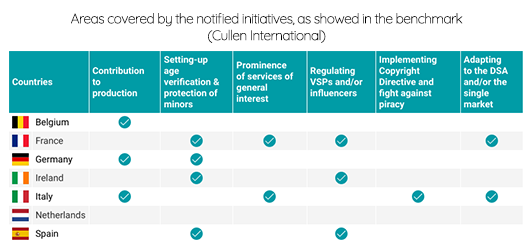
Concerns raised by the Commission
France and Italy have notified the most initiatives in 2023 and 2024. They are therefore the countries which received the most detailed opinions or non-binding comments from the Commission (see section on elements of procedure above). Most of the objections raised by the Commission are linked to the incompatibility of the draft initiatives in relation to the country of origin principle of the Electronic Commerce Directive, and to the full harmonisation introduced by the Digital Services Act (DSA).
For more information and access to the benchmark, please click on “Access the full content” - or on “Request Access”, in case you are not subscribed to our European Media service.
more news
04 November 26
In nine European countries, national symmetric obligations on access to ducts go beyond the scope set by the Gigabit Infrastructure Act
Cullen International's latest benchmark analyses asymmetric and symmetric duct access obligations in Europe.
04 November 26
More than 60 cases and counting: a snapshot of European antitrust enforcement against big tech
Cullen International’s latest report on past and pending antitrust cases against big tech companies in Europe tracks enforcement activity under ex post antitrust rules at EU and national level.
30 October 26
Many governments around the globe rely on legal mechanisms to compel communications apps to cooperate in law enforcement investigations
Cullen International's latest Global Trends benchmark for number-independent communications apps regulation found that nearly all of the 13 surveyed jurisdictions around the world provide some legal mechanism to make these apps assist law enforcement in criminal investigations. There are requirements to verify user identities, compel disclosure of stored content, make encrypted content accessible, and duties to detect illegal content within private communications.