The European Commission considers that reviewing the weighted average cost of capital (WACC) at least once per year is appropriate to take account of recent economic conditions, but many countries adopt a longer periodicity, and some update it only when doing a new market analysis.
When setting regulated wholesale prices, national regulatory authorities (NRA) must allow for a reasonable return (Article 74.1 EECC). NRAs can do this by estimating the cost of capital of an efficient operator as a weighted average between the return investors expect on their equity and the financing costs of loans and other debts.
In the WACC formula:

- R(E) is the cost of equity;
- R(D) is the cost of debt;
- E is the value of equity;
- D is the value of debt;
- D+E is company value.
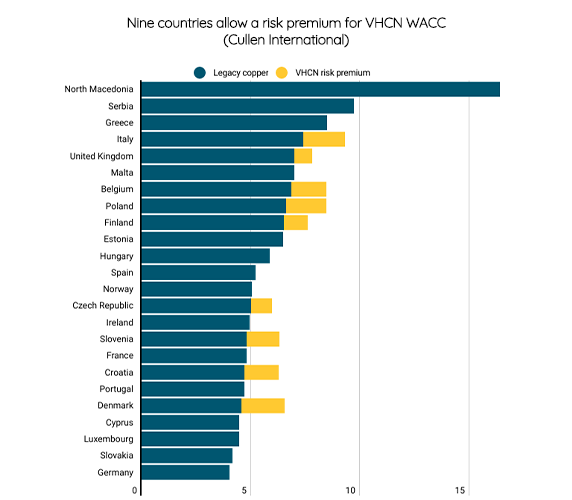
NRAs must also take into account any risks specific to a particular new investment network project (Article 74.1 EECC). Some NRAs therefore allow for a higher cost of capital for investments in very high capacity networks (VHCN) with a risk premium, which would translate into higher wholesale access prices on those networks if they are regulated.
Our benchmark compares for 32 European countries:
- WACC values and the parameters NRAs use;
- risk premiums for VHCN; and
- how often NRAs review the WACC.
To access the full benchmark, please click on “Access the full content” - or on “Request Access”, in case you are not subscribed to our European Telecoms service.
more news
20 May 26
Spectrum sharing in Europe
Spectrum is a scarce resource and can be used more efficiently when multiple users agree to share it. Cullen International designed two new benchmarks that examine the regulation and practice of spectrum sharing in 21 European countries.
13 May 26
Protection of minors: national rules to protect minors from exposure to pornographic content in Europe
Our latest benchmark shows the initiatives proposed or in place in selected European countries to control or restrict the exposure of minors to online pornographic content.
12 May 26
Some EU member states pre-empt EU level small parcel handling fee
Our new benchmark shows whether EU member states are applying a specific small parcel handling fee, compares fee levels, the legal basis, collection mechanisms, and implementation status.